
- The Résumé
Until now, my search for my great-uncle Michael has proceeded one document at a time: a Palestinian naturalization certificate, a passport, a British Army record, an American immigration document. Each gave me another glimpse of the man.
Then I found his résumé. It is a long story. We’ll get back to that some other time.
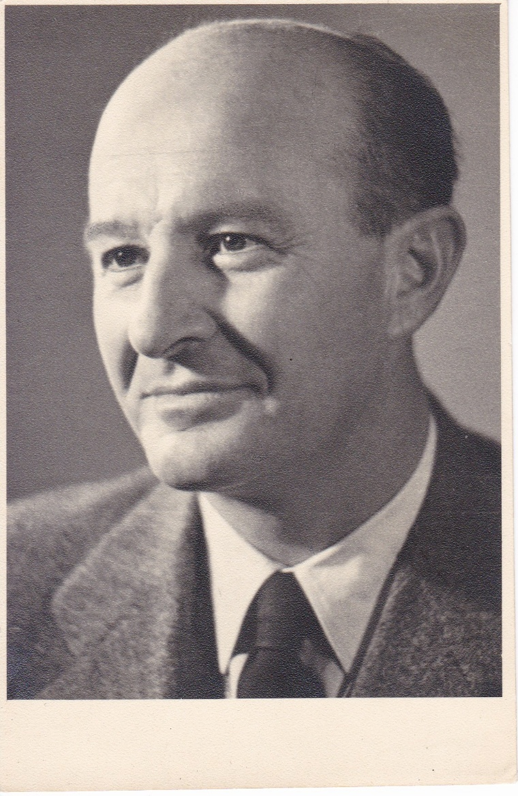
Image: Michael Rubin
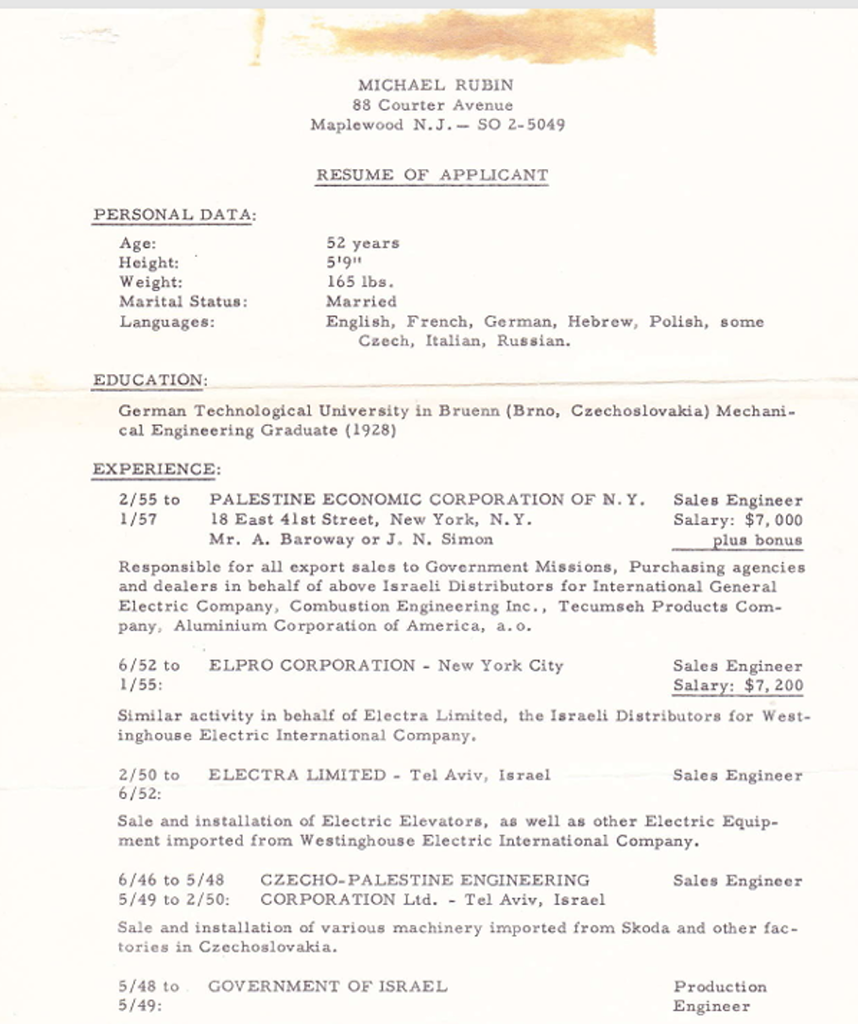
In two pages, Michael suddenly accounts for nearly thirty years of his life. And the man who emerges is considerably more interesting than I had imagined.
Michael graduated in mechanical engineering in 1928 from the German Technological University in Brno, Czechoslovakia. He began his career designing high-pressure steam boilers in Danzig, then moved to Paris, where his work included hydraulic turbines, cranes and hoists. He subsequently worked as a consulting engineer on boilers and hydraulic turbines for factories in Poland and France.
Then, in 1935, he came to Palestine.
Image: Michael’s résumé, page 1
2. Three turbines at the Jordan Station
Michael’s first recorded employment in Palestine was with the Palestine Electric Corporation.
His résumé describes his work there in a single line:
“Overhauled 3 hydraulic turbines at the Jordan Station.”
The “Jordan Station” was the hydroelectric power plant at Naharayim, built by Pinhas Rutenberg’s Palestine Electric Corporation at the confluence of the Jordan and Yarmouk rivers. It was one of the great infrastructure projects of Mandatory Palestine, and was inaugurated with much fanfare (see image below)
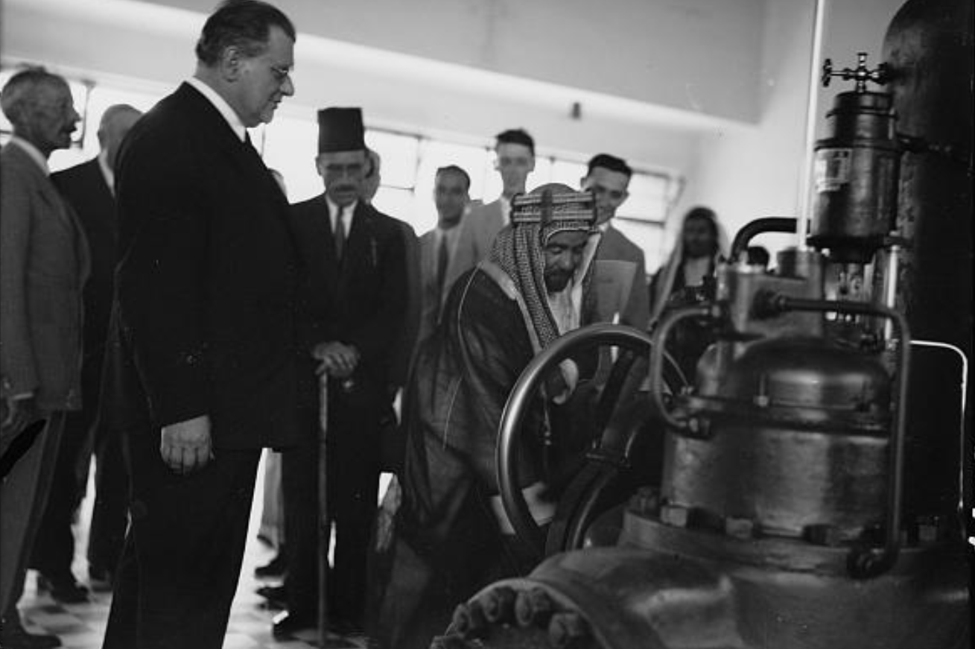
Image: Emir Abdullah of Transjordan starts the turbines at the Palestine Electric Corporation’s Jordan hydroelectric station at Naharayim, as Pinhas Rutenberg watches at left, 1933. Two years later, Michael Rubin’s résumé records that he was working here, overhauling three hydraulic turbines. Library of Congress, Matson Collection. Michael was unusually well prepared for the job. His earlier work in Europe had already given him experience with hydraulic turbines.
And there is an intriguing detail.
Contemporary British records describe the Naharayim (Two Rivers, literally) powerhouse as having three turbine sets.
Michael says he overhauled three hydraulic turbines. As a hydraulic engineer, I recognize how demanding and impressive that project must have been.
I cannot establish from the résumé alone that Michael worked on the station’s entire turbine installation. But the numbers are certainly suggestive.
For a young immigrant engineer newly arrived in Palestine, it was quite an assignment.
Michael’s career then moved increasingly from engineering design toward the sale, installation and management of industrial equipment.
3. Second World War and Later
The Second World War interrupted that career. From 1942 until 1946 he served as a captain in the British Army’s Royal Engineers, during the North African and Italian campaigns.
After the war, he returned to Palestine and joined the Czecho-Palestine Engineering Corporation in Tel Aviv. His job involved the sale and installation of machinery imported from Škoda and other Czechoslovak factories.
4. And then, America
The résumé also corrects something I reported in an earlier update.
I had thought Michael’s first record of entry into the United States was in 1954.
It wasn’t.
By June 1952, Michael was already working in New York as a sales engineer. The later immigration document I found therefore records a subsequent entry into the United States, not his original arrival.
That is one of the pleasures—and hazards—of doing family history in public. A new document occasionally arrives to tell you that something you thought you knew was wrong.
In 1955 Michael moved to another New York employer:
The Palestine Economic Corporation.
When I first encountered that name, it struck me as another historical curiosity. Israel had existed since 1948, yet here was Michael, living in America in the 1950s, working for a company that still called itself the Palestine Economic Corporation.
It reminded me of the passport discussed in an earlier update: in June 1949, more than a year after the establishment of Israel, Michael’s passport was renewed on a form still headed Government of Palestine (see previous updates)
At first, I saw these as bureaucratic leftovers from a country that no longer existed.
Michael’s résumé made me see them differently.
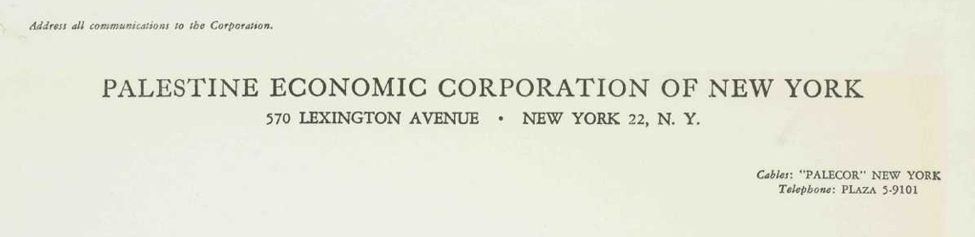
Image: Palestine Economic Corporation letterhead, New York, 1955
By then, Palestine had been part of Michael’s adult life for nearly two decades. He had worked on its electrical infrastructure. He had sold machinery to its industries. He had served in the British Army from there. After 1948, he worked for the Government of Israel and then returned to one of the companies in which he had worked before independence.
The Palestine Economic Corporation itself illustrates the continuity. Founded in the 1920s to promote economic development in Palestine, after 1948 it continued investing in and promoting Israeli industry—while retaining its old name until 1962.
So perhaps the recurring word Palestine in Michael’s documents is more than an amusing bureaucratic anachronism.
I cannot know how Michael himself understood the word or what national identity he attached to it. But Palestine unquestionably belonged to his biography.
Governments and borders can change in a day. People’s lives don’t divide themselves quite so neatly.
5. A Man Comes into Focus
By the time Michael prepared this résumé, he had become something of an international industrial intermediary—an engineer who could understand machinery, sell it, install it and move comfortably between manufacturers, governments and customers in different countries.
The languages he listed are almost a résumé of that life:
English, French, German, Hebrew and Polish, with some Czech, Italian and Russian.
Eight languages, at varying levels.
And at the top of the résumé was something much more ordinary:
88 Courter Avenue
Maplewood, New Jersey
Age: 52.
Marital status: Married.
For the first time since I began looking for Michael, I feel that I can see something of the man rather than merely follow his trail through documents.
We know now where he studied. We can follow him through Danzig and Paris, Palestine and the British Army, the birth of Israel, New York and finally suburban New Jersey.
But there is one thing this remarkably detailed résumé does not explain.
Michael had a family.
And somewhere along this journey, he seems to have disappeared from their lives.
That is where the search goes next.
