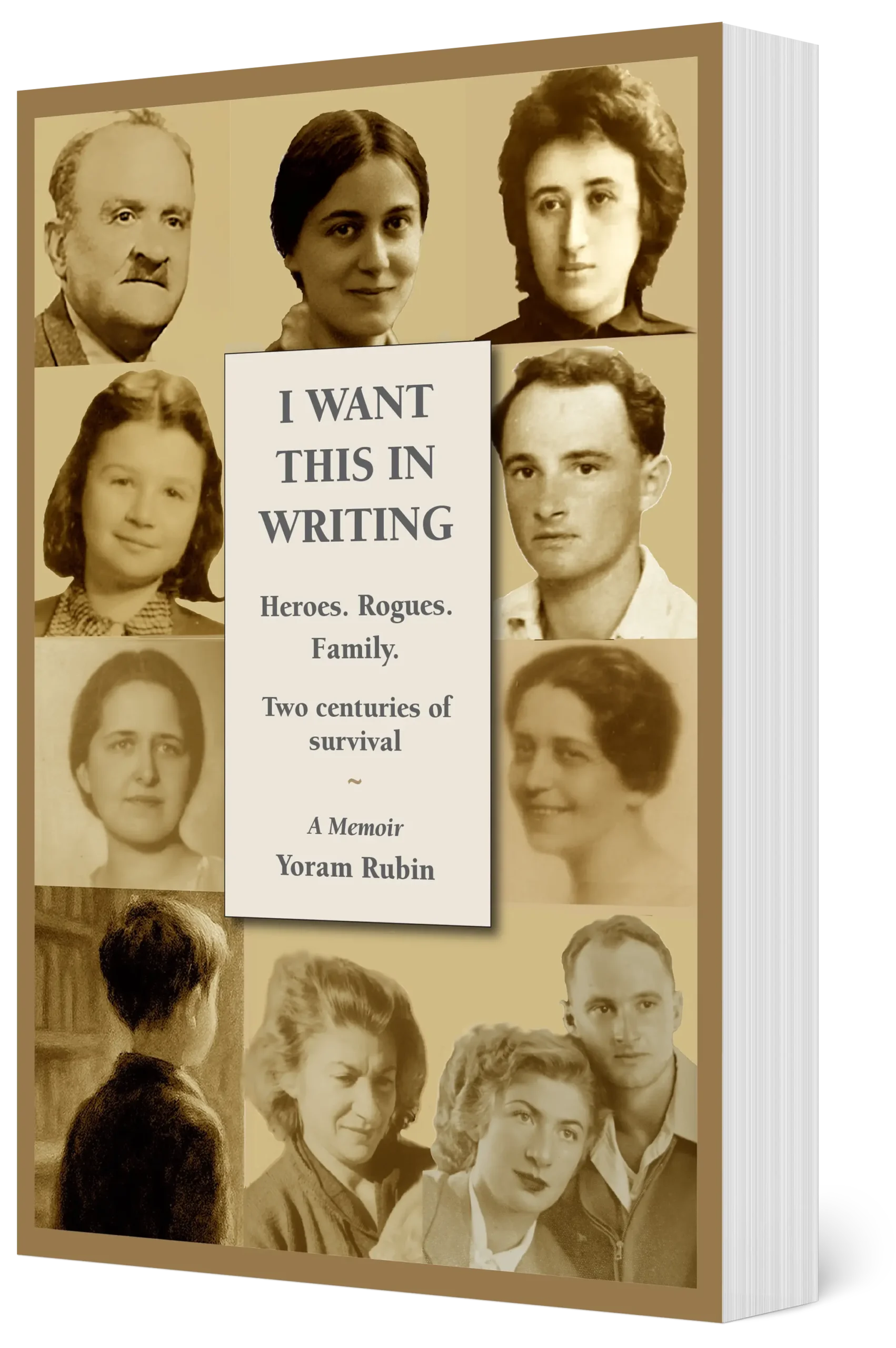
I Want This in Writing
Heroes, Rogues, Family: Two Centuries of Survival
“How much of who we are is shaped by people we never had the chance to know?”
When scientist Yoram Rubin set out to investigate five generations of relatives he had never met, he expected to uncover forgotten names, faded photographs, and long-lost documents. Instead, he discovered something far more unsettling: the dead had been shaping his life all along.
What begins in present-day California unfolds into an extraordinary journey spanning more than three centuries of European and Jewish history. At its center stand Rubin’s father and grandfather—two antiquarian booksellers who survived Nazi-occupied Poland using little more than forged identities, extraordinary resourcefulness, and what they called their “Aryan good looks.” But this is not a conventional Holocaust memoir.
As Rubin digs deeper, the story expands far beyond the war. Hidden behind decades of silence lies an entirely unknown branch of the Rubin family: radical philosophers, celebrated scholars, communist revolutionaries, remarkable women, religious converts, and unexpected heroes. Alongside them stand Rubin’s own flawed-but-fearless ancestors—street fighters, gamblers, idealists, survivors, and family patriarchs whose choices continued to reverberate long after they were gone.
The investigation gradually becomes personal. Much of what Rubin believed about his own family—and about European Jews before the Holocaust—begins to unravel. Boys who boxed with Ukrainian rivals. A father whose childhood hero was heavyweight champion Joe Louis. A forgotten family that might have changed the course of his own life. The deeper he searches, the more he discovers that history is rarely populated by saints and villains. Instead, it is inhabited by complicated men and women whose decisions were shaped by fear, pride, courage, love, ambition, desperation, and impossible moral choices.
Drawing on decades of interviews, private letters, archival discoveries, and historical research, Rubin approaches his family much as he approached the hidden groundwater systems he studied throughout his scientific career: assembling fragments of evidence, accepting uncertainty where certainty is impossible, and searching for the invisible structures beneath the surface. The result is neither an indictment nor a defense of his ancestors, but an honest attempt to understand them.
The story moves effortlessly from the court of Emperor Franz Joseph to Nazi-occupied Poland, from Vienna’s intellectual circles to Mossad-directed operations after the war, from forgotten Galician villages to present-day California. Along the way it explores exile, family loyalty, social erasure, faith, identity, betrayal, reconciliation, and the enduring consequences of choices made under extraordinary circumstances.
Most readers, like the author, have never stood in wartime Warsaw or prewar Kraków, but they understand loss, family bonds, exclusion, love, longing, and the desire to belong. Those emotions are the bridge between their world and the author’s, and they are what bring these settings to life.
Written with unsparing honesty, dark humor, and deep compassion, I Want This in Writing is part detective story, part historical investigation, and part deeply personal memoir. Above all, it is an exploration of the invisible ways families shape us across generations—and of how understanding, even when it cannot bring complete forgiveness or certainty, can restore dignity to the dead and leave the living with a deeper understanding of themselves.