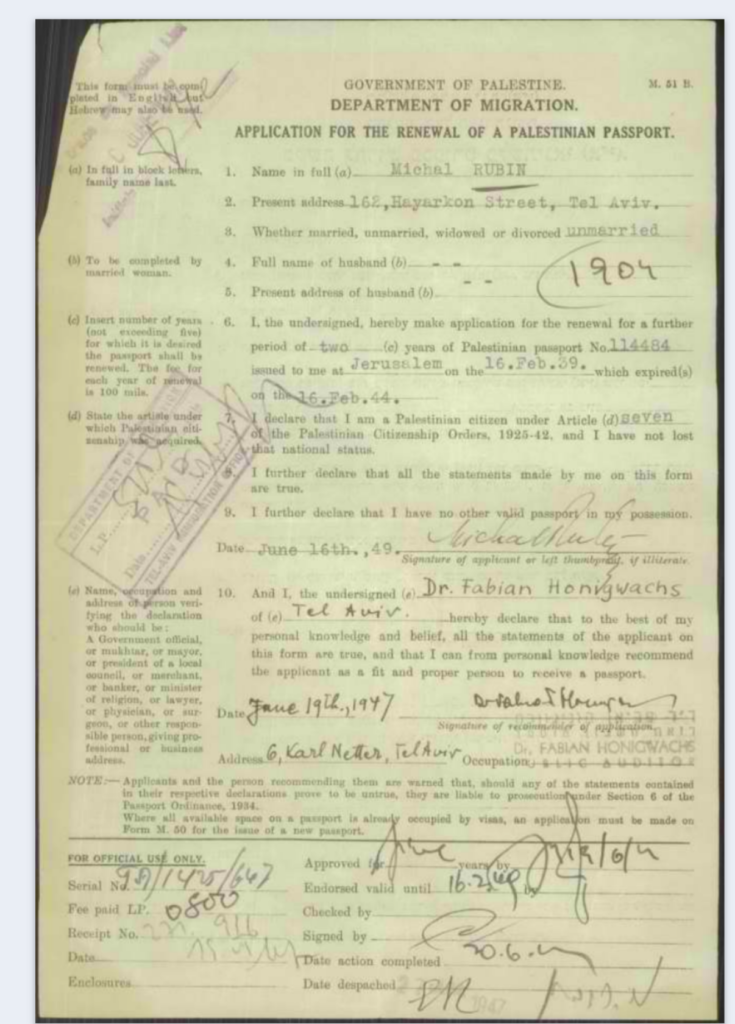
My sister Irit discovered a new document.
It shows Michael to be a holder of a passport from a country that no longer exists.
It begins like a contradiction—almost like a mistake.
A document dated June 1949.
The address: Tel Aviv.
The applicant: Michael Rubin, a Jew, living in what is already the State of Israel.
And yet, at the top of the page, in firm, official type:
“Government of Palestine.”
Below it, without hesitation, the bureaucracy proceeds.
An application. A renewal. A passport issued years earlier in Jerusalem—February 1939—now extended, approved, stamped, signed. Everything in order.
But how can this be?
There is no “Government of Palestine” in 1949.
That entity ended—at least politically—with the British departure in May 1948. In its place stands a new state, declared, fighting, consolidating itself: Israel.
And still, in Tel Aviv—its beating administrative heart—someone processes a passport renewal on a form that belongs to a vanished regime.
It feels like a ghost at work.
A government that no longer exists, continuing to issue documents to people who no longer belong to it.
The explanation is likely less dramatic—but in its own way, more revealing.
States change overnight.
Paperwork does not.
When Israel was established in May 1948, it did not begin from nothing. There was no empty desk, no blank ledger. Instead, it inherited an entire administrative machine from the British Mandate: laws, offices, clerks, filing systems—and stacks of printed forms headed “Government of Palestine.”
And so the new state did what states often do in moments of rupture:
it continued.
Under the Law and Administration Ordinance of 1948, existing laws and procedures remained in force unless explicitly replaced. That included the passport system. There were no new Israeli passports ready for immediate distribution, no fully restructured bureaucracy waiting in reserve.
So the old system kept running.
Clerks in Tel Aviv sat at desks once belonging—at least in name—to the Mandate. They used the forms they had. They processed applications as they always had. They stamped documents that still bore the title of a government that had disappeared.
For a time—months, even years—the legal identity of individuals lagged behind political reality. A man could live in Israel, under Israeli authority, and still declare, on paper, that he was a “Palestinian citizen,” because that was the legal category that had not yet been fully replaced.
Only later, with the Israeli Nationality Law of 1952, did the system catch up. Citizenship was redefined. Passports were reissued. The language changed. The old forms vanished.
But in 1949, that transformation was still incomplete.
What we are seeing, then, is not an anomaly.
It is a document from a narrow, fleeting moment—
when one state had ended, another had begun,
and in between, the machinery of daily life simply kept going.
A passport renewed by a government that no longer existed,
for a citizen of a country that was still learning how to name itself.
And in that quiet administrative continuity, the past lingers—
not as memory, but as ink, paper, and the steady hand of a clerk in Tel Aviv.
It is clear that Uncle Michael was in Tel-Aviv from 1948 to 1949, getting ready to go overseas. During his time in Israel, he did not see any family members, which may be related to a dispute they had in Vienna at the end of 1945. Further details will be discussed later.