
In Part 1 of this series, I discussed Uriel Da Costa and Spinoza and their encounters with the Jewish religious authorities, and the subsequent herems. Uriel da Costa and Baruch Spinoza rank high on the list of grand herems. “Grand” like in theatrical and vicious. They both took place in the early 17th century, almost 400 years ago. Two hundred years after they took place, these herems shook my family, the Rubins, to the core. And the first hit was also in the form of a herem. That one took place roughly 170 years ago.
The Rubins have felt ongoing aftershocks ever since. What started as a flap of the wings in Amsterdam was turning into a tornado in Galicia.
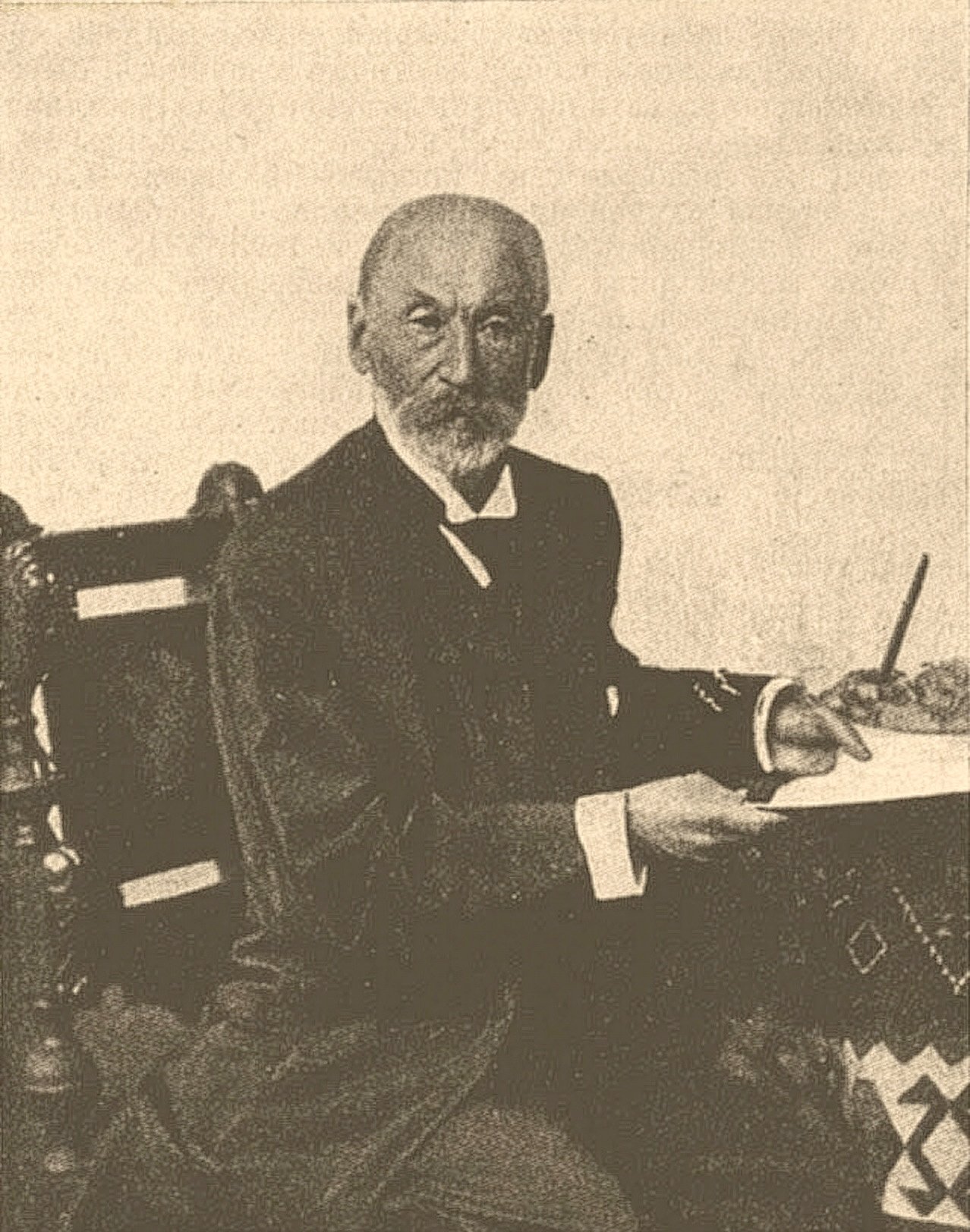
Salomon Rubin (1823–1910) was the first to experience the aftershock, and it was also in the form of a herem. His herem did not draw many headlines. But it was a long, drawn-out process. He fast-tracked himself to being banned and exiled from his family at an early age. And what started as a family herem was soon followed by a broad communal one. At the age pf 33, Salomon was ‘ghosted’ for life.
Salomon’s life story unfolds like a train wreck in slow motion.
The First Salomon Rubin Herem
Salomon Rubin’s story begins in the Galician town of Dolina, near the Polish-Ukrainian border. As expected of Jewish men of his background at the time, young Salomon spends all his time studying the Jewish holy books in Beth-Hamidrash [House of Study]. By his late teens, Salomon is recognized as an Ilui [genius] and as such, he is guaranteed a rabbinical position. He marries Malka at seventeen. There is no information available about her. It is an arranged marriage. Following tradition, his elders secure a rabbinical position for him, and his wife’s family commits to support him financially—incidentally, this is a common arrangement at that time: you want your daughter to marry a rabbi, you pay. With the backing of his family of prominent rabbis and religious scholars, and with the financial support of Malka’s family, Salomon has his career path carved out for him.
Except that Salomon discovers Emancipation, and he rebels.
The young man destined for rabbinical greatness is spotted wandering outside town and reading forbidden books—the kind of books a future rabbi could not afford to be seen with. His absence from Beth-Hamidrash is noted and duly reported to his family.
This is when Salomon discovers Spinoza. From that point onward, he hopes—and even strives —to reclaim Spinoza for Jewish intellectual history, insisting that Judaism must withstand the scrutiny of reason rather than rely on dogma alone. He also suggests that one could remain traditional while, at the same time, thinking beyond the permitted borders of tradition—identifying with one’s heritage need not require submitting to it intellectually.
For his close family circle, this is blasphemy.
Salomon’s father and father-in-law press him to reverse course. To no avail.
And there are consequences. The rabbinical appointment that had been offered is rescinded, resulting in the near complete loss of financial assistance from his in-laws. Next to react are his friends, who ban him from entering the Beth-Hamidrash Dolina. Then, it is his family’s big moment. One would hope that, like the Spinoza family, they would stick by their wayward son—but alas, given their rabbinical stature in the community, they feel compelled to self-protect, and so they disengage from him. He is herem’ed. It is for real, and it is irreversible.
These are the early signs of the tornado.
This family-induced herem marks the beginning of an agonizing path for Salomon, who is in his late teens at the time. First comes the breakup from his biological family, including his brother Matityahu. Soon thereafter, Salomon, his wife Malka and their young family are forced to leave his in-laws’ house, and Salomon must work for a living. While working for a living is not a shocker by today’s standards, it is unusual at the time—and it still is, among Orthodox Jews, where one is expected to dedicate all one’s time to religious studies.
Unfortunately, the community is not forthcoming with job offers. Salomon learns bookkeeping and attempts to pursue a career in business. At the age of twenty-three, following a series of disappointments in commerce, Salomon runs out of savings. Malka and their first two children return to her parents’ house, while Salomon journeys around, working in various positions. He keeps sending money home, and he even meets with Malka on occasion; they have four children together: Isidor, Hirsch, Frieda, and one more girl, name unknown. Yet, despite Salmon’s hard work, Malka and the children live in poverty most of the time. Malka is a single parent with limited finances. She is the primary caretaker of four children, three of whom will die at an early age. I do not have medical records to make a definitive statement, but being a single-parent family living near the poverty line is not conducive to healthy infants. Yes, child mortality was prevalent at the time, but, again, it’s reasonable to assume that the meager financial resources—due to Salomon’s social isolation and lack of family and community support—have contributed to this tragedy.
And if you are expecting Salomon to change his ways and to seek acceptance… well, that did not happen.
How many children had to die for Salomon to change his mind? This question is obviously loaded with assumptions.
And did Malka accept the family’s misfortunes calmly? Very little that is known about her despite extensive searches. She is not mentioned in any of Salomon’s letters. I suspect they live separately.
But Salomon is even further radicalized:
- He presents Spinoza as the New Guide to the Perplexed. This is a loaded term. To crown the rebellious blasphemer with a title reserved for the greatest of great rabbis is nothing short of heresy.
- He denounces Jewish priests and rabbis throughout the ages for their autocratic behavior.
- He analyzes the sources of Jewish superstition, attachment to vain legends, hollow beliefs, and futile customs and rules.
- He translates every branch of science into Hebrew and published extensively on them, thus countering those who considered the Talmud and its interpreters as the extreme boundary of human wisdom.
- Influenced by the Haskalah [Emancipation], he argues that Judaism must withstand philosophical scrutiny, emphasizing reason, textual criticism, and historical awareness rather than unquestioned rabbinic authority.
- He publishes Spider Web, where, using Salomon’s words, he “admonished their crooked ways, and explained a mere trifle of their obscure doctrines, and roused my brothers my brothers to open their eyes and hearken to what the new times demanded of them.”
Salomon self-publishes extensively on a variety of topics outside religion, including multiple branches of- science, history and psychology. He prints his books under his own name and markets them independently, passing the traditional bookstore marketing strategy by distributing lists of his books and mailing out the orders received.
Salmon publishes all his work in Hebrew although he is fluent in many languages. He is aiming at young Hebrew speakers. That puts the rabbis on edge. In his A Simple Story, Nobel laureate S.Y. Agnon provides some anecdotal evidence. He describes the patients of Dr. Langsam, a medical doctor in Lemberg (also called Lwów and Lviv, a town in Galicia, and the hometown of my Rubin elders) who specializes in mental diseases. One of these patients is “… a tall, thin, uncommunicative man who, when he was not looking for water to wash his hands with or cursing the well-known Jewish Spinozist Shlomo [Salomon] Rubin, preferred to be left to himself. The mere mention of Rubin, however, made Feibush spit angrily on the ground, for the man [Rubin] had invented a mechanical dog with [a] gauge in his mouth that could register one’s every thought.”
But it is not just Salomon presenting his ideas and sharing insider knowledge of the Hassidic courts to the broad public that brings upon him the wrath of the religious establishment. It is also the way he did it.
In The First Modern Jew, Daniel B. Schwartz comments on Salomon’s use of Hebrew. He notes the use of what he calls “a highly florid and allusive Hebrew known as melitsah” and adds that it “could easily be adapted for seditious ends, since it abetted the transposing of deviant subject matter into a familiar register.” Think about the local cantor singing choice phrases from Spinoza during Saturday morning service.
And there’s also the tone he uses. Salomon does not use a restrained academic tone. He is ironic and at times condescending. In his book Tehilat Ha-Ksilim (The Praise of Fools), Salomon presents Lob Der Thoren: Das Neuste Testament eines gläubigen Langhor’s (Praise of Fools: The New Testament of the Faithful Long-eared).
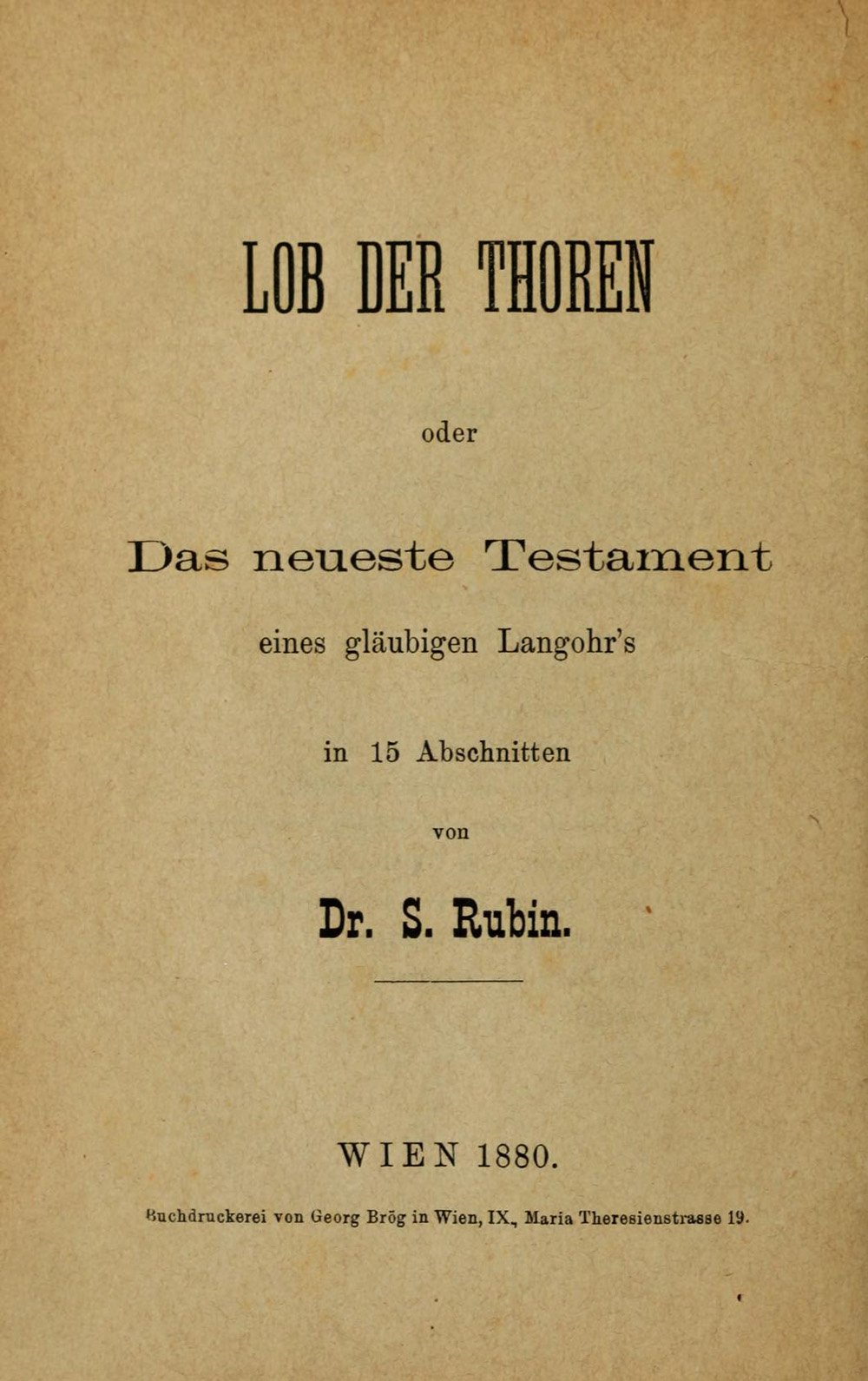
Long-eared? Really? Yes, really.
Salomon criticizes, argues and ridicules.
With this, Salomon crosses his Rubicon.
The Second Herem
In 1856, at the age of thirty-three, Salomon is placed under a rabbinically-sanctioned ḥerem. The act itself does not reach the dramatic highs of Uriel and Spinoza herems two centuries earlier in Amsterdam. Salomon does not earn himself a herem statement deserving of the Herem Hall of Fame (Spinoza). There is no lashing and no lying on the floor as a doormat (Uriel). But it does leave an impression. Salmon describes a gathering in Galicia, where “The rabbis, judges and Hasidim, like a colony of locusts, gathered against me, shouting ‘Herem’ – all on account of my book Spider Web, in which I admonished their crooked ways…”
The rabbis want neither to grab headlines nor having yet another dead martyr to haunt them. Still, they want to annihilate Salomon, both socially and professionally. Salomon becomes persona non grata in Galicia and is forced to expand his universe. He travels far and wide, all alone, to pursue an income. He serves as a tutor for affluent families throughout Europe, including Italy and Russia, as well as in San Francisco.
In the mid-1850s, at the onset of the herem, Salomon comes across the writings of German playwright Karl Ferdinand Gutzkow. Gutzkow catches his attention: both are interested in social justice and in the study of religions, and both fiercely object to religious coercion. Gutzkow’s ideas on these topics inspired his famous play, Uriel Acosta. Salomon reads this play and is smitten by the portrayal of Uriel. He translates it to Hebrew and publishes it, not missing any of the inflammatory comments such as this one, mentioned earlier:
The Christians’ faith rejected by my heart.
And then again, professing Jacob’s faith
With outward show and base hypocrisy,
I was not Jew, nor Christian, hated both.
Gutzkow’s Uriel Acosta provides a key to understanding the state of mind of the rebellious scholar. Salomon’s interest in this play stemmed not just from its dramatic elements or shared ideologies, but also because he identified with Uriel’s experiences as a form of self-defense. Amnon Jackont wrote the following in his 2006 PhD thesis:
“Beyond the personal interest that Gutzkow’s play stirred in him [Salomon Rubin], the question arises why Rubin, among all the “apostates” of the Haskalah, chose to engage with someone [Uriel] who had strayed from his path and returned to religious observance. The answer seems to lie in Rubin’s recognition of Acosta and in the psychological parallels between Acosta’s experiences and events in Rubin’s own life.
Acosta’s great sacrifice — his abandonment of the path of truth and his submission to the orders of the Jewish court in Amsterdam — stems, as presented in the play, from his devotion to his family. Attachment to family led to intellectual castration and personal sacrifice.”
One may similarly raise questions about Rubin’s own commitment to his family, whom he loved, yet in some sense also abandoned, and to the family he established — which he not infrequently neglected, at times, in pursuit of livelihood in a foreign environment — perhaps stirring feelings of guilt within him.
Genealogy of a Herem
Jackont adds that Gutzkow’s play ”served Rubin well in illustrating to himself, and perhaps also to his critics, that had he yielded to familial sentiments, he would have suffered spiritual ruin.” This might very well be true. Salomon apparently prioritizes his personal interests over the needs of those who rely on him.
The impacts of Salomon’s herem—on both his immediate family and his descendants, are startling. And the herem impacts propagate over time.
The First Generation
Isidor Rubin is Salomon’s only child surviving into adulthood. Born in 1843, Isidor is raised as a secular Jew. In 1878, he marries into a highly assimilated Jewish family, the Loewensteins, based in Lwów (now part of present-day Ukraine). His wife, Alma, is the sister of Nathan Loewenstein, aka Baron von Opoka, also from Galicia. Nathan is a leading assimilationist. An eloquent orator, he is a well-known attorney, a deputy at the Austro-Hungarian congress in Vienna, and the leader of the Polish circle in the Austro-Hungarian parliament.
Notably, the descendants of Matityahu Rubin, Salomon’s estranged brother, live in that same town. There is no known contact between the two branches of the families. The family breakup is in force.
In May of 1887, Isidor tries to take his own life. The Viennese Newspaper “Neues Wiener Tagblatt” reports on May 18th, 1887: “At the Crown-Prince Rudolph-Bridge, [a] business card was found. Written on it was the note: Isidor Rubin, Railway Engineer, I sprang into the Water. Motive: chronic disease. That is Isidor’s suicide note. The suicide attempt fails, and Isidor will die fourteen years later, presumably of natural causes. Salomon explains later that the suicide attempt followed an unrequited love affair.
Back to Salomon.
Salomon is reportedly miserable and socially isolated throughout his later adult life (late nineteenth and early twentieth centuries). Jackont (2006) explains that:
Salomon Rubin lived between tradition and reason. Drawn to Spinoza’s uncompromising rationalism yet still bound by an emotional attachment to Jewish tradition, he could not wholly accept either world or abandon it. What emerged was a fragile intellectual compromise—less a resolution than a life shaped by the tension of belonging to two traditions at once.
Away from his family and isolated from the community, Jewish and otherwise. That pretty much summarizes Salomon Rubin late in life. That is what herems are for. And they are effective if you do not plan. Salomon had only to look at Spinoza’s life for clues on how to survive a herem.
In our next installment, we’ll examine the tragic legacy of the herem.
