
How a Polish doctor helped Jews survive Nazi identity checks by changing their bodies — and sometimes their official deaths.
My father survived the Holocaust in part because a Polish doctor performed surgery to make him look less Jewish.
In my book I Want This in Writing (Artur’s Rules of Conspiracy) I described surgical miracles performed by a Polish doctor during WWII. Documents I recently discovered in German post–World War II archives finally revealed his name: Dr. Andrzej Trojanowski.
The good Dr. Trojanowski — Dr. T, if I may — saved many lives.
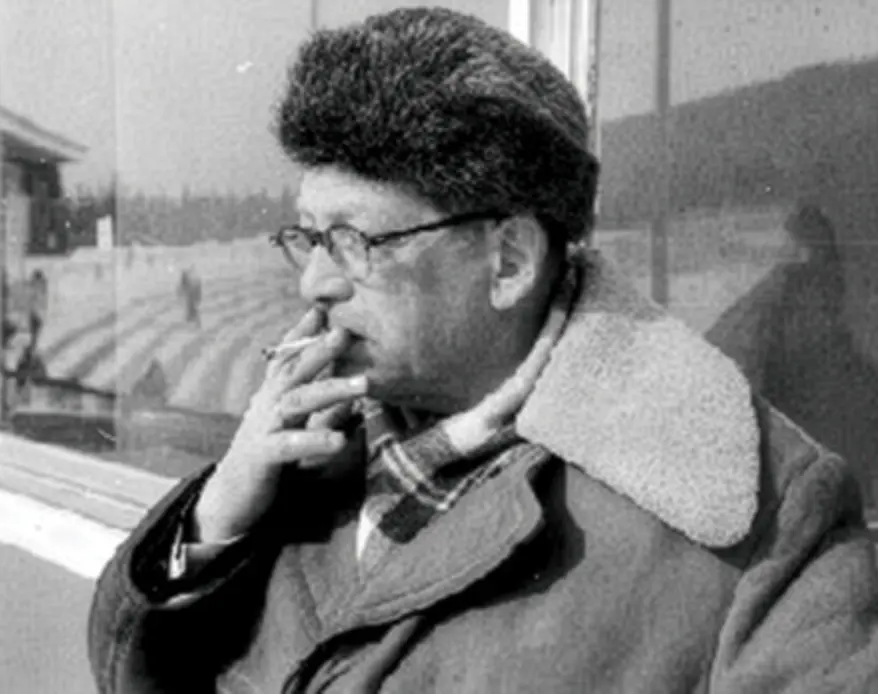
Until recently, I knew very little about Dr. T. That changed when I recruited MD, my Polish cousin, to help investigate. She did some research and shared her findings with me. As I suspected, Dr. T was a hero, and many people benefited from his medical skill and his courageous heart.
The Polish online magazine Gazeta_Otwocka reported:
“At the risk of his own safety and that of his family, he [Dr. T] saved the lives of many people of Jewish origin. He operated on the noses and foreskins of about thirty Jews, took care of the four children of his Jewish friend, placing them in various safe places. They often stayed with his family in Świdra during the holidays.”
I know of two of the thirty people Dr. T operated on.
One of them is my father.
This is not a historical anecdote for me.
Dr. T performed a cosmetic reconstruction operation on my father, attempting to give him what might be called an Aryan penis. My father never knew the name of the doctor who operated on him. He was deliberately not told, in order to protect the doctor’s identity. My grandfather arranged the operation.
So how did I eventually learn the surgeon’s name?
It turns out Dr. T operated on my grandfather as well. The Old Man kept with him a medical certificate issued by Dr. T so that he could show it to anyone curious about the shape of his penis.
And there were many such people: the szmalcowniks (financial blackmailers) and, of course, the SS — who would simply kill you.
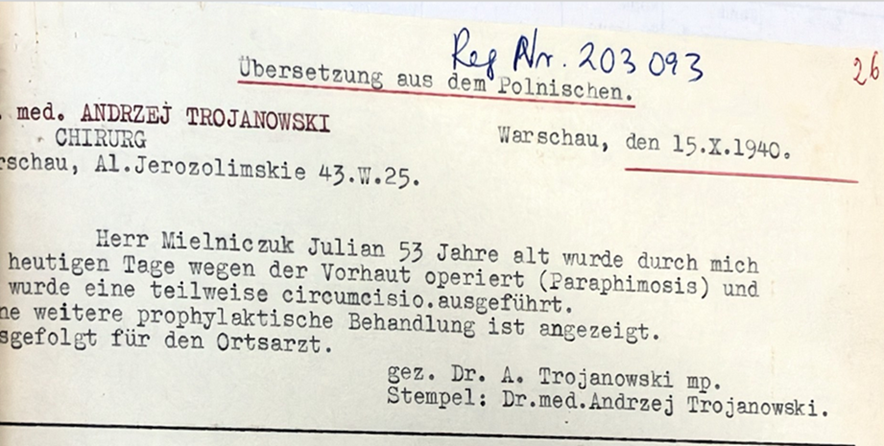
But the good doctor’s skills went far beyond that single operation.
A more detailed account of Dr. T’s medical work appears in the following article (in Polish): He corrected “bad looks” (Andrzej Trojanowski) – Żydzi otwocky / The Jews of Otwock, which reports:
“Dr. Trojanowski probably performed about 50 surgeries to remove the effects of circumcision, several nose surgeries (he could make a wide, flattened boxing nose out of a humpback nose), and also undertook ear-flattening operations. These procedures were carried out in his office in Otwock, but also in patients’ homes.”
Dr. T functioned as a one-stop clinic for persecuted Jews in hiding.
Not just cosmetic surgeries.
He provided a range of services essential for survival.
One of these services was issuing medical certificates — for example, exemptions from obligatory typhus immunizations.
Jews living under assumed identities wanted to avoid mass vaccination lines whenever possible. Such gatherings were dangerous. An old schoolmate might greet them in Yiddish. Someone might call them by their abandoned Jewish name.
My father feared exactly this.
He was born Artur. But beginning in mid-1941 he assumed the identity of Tadeusz Mieczysław Panko.
Yet Artur-turned-Tadeusz and others like him still needed vaccination documentation to receive food coupons. Medical exemptions offered an elegant solution.
You stand in line for some service, present your Kennkarte — your forged German identity document — and when asked about vaccination you calmly show the doctor’s note.
Cool.
Calm.
Controlled.
But even this did not solve all problems.
Changing identity — performing a true vanishing act — was far more complicated. One major danger lay in the archival system the Nazis used to track people.
The Nazis built their identification system on pre-existing Polish civil, religious, municipal, and police archives. After the invasion of 1939, they seized or controlled these offices.
In the General Government (Generalgouvernement, the Nazi administrative name for occupied Poland), records were centralized and cross-checked. These archives contained birth certificates, marriage records, death records, parents’ names, and religious affiliation. The Nazis supplemented these records with new registration systems.
Yet the system’s strength was also its weakness.
If someone could insert themselves into the registry under a new identity, they could sometimes disappear.
But first they had to remove their old identity from the system.
Bribery was one option. Someone with access to the archives might be paid to erase records. But finding a trustworthy person who could access all relevant documents was rarely realistic.
There was a simpler solution.
Dying.
Not literally dying — but officially dying.
A death certificate followed by a properly arranged burial ceremony could close the file. Doctors were essential in arranging the paperwork for such deaths and the funerals of people who had to disappear underground (no, not that underground).
This is where the good Dr. T and his associates entered the story.
Dr. Trojanowski died of a heart attack on March 19, 1964, at the age of fifty-nine. In 1966 the State of Israel recognized him as Righteous Among the Nations.
That is the official ending of his story.
But it is not the end of the question.
The motivation behind gathering the histories featured on this website came from stories like this — accounts of individuals who managed to endure historical challenges by taking on new identities.
Dr. T’s life story confronts me with an uncomfortable question:
Would I have done the same?
There is no believable answer to that question unless one has already risked one’s life to save others.
And another question follows.
If you did not risk your life to save others — does that make you a coward?
I do not know.
I will have to return to that question later.

[…] More information about this story is available here. […]