
Born Jewish and living in Nazi-occupied Poland with a borrowed Christian identity, Artur had to adapt to new rules of behavior. To endure meant blending in flawlessly, leaving no trace, and accepting isolation as the price of life. This is a meditation on lives lived under borrowed identities, where survival depends on disappearance, trust becomes perilous, and the self endures only by learning how to vanish in plain sight.
Part One: Rules to Live By
Artur’s Laws of Conspiracy for Life Under the Nazis
• Move away from your hometown to where nobody knows you.
• Get yourself a new name and new ID papers.
• Avoid villages and small towns.
• Don’t hang out with anyone who might know or even suspect that you are Jewish.
• Don’t tell anyone you are a Jew, even if they appear trustworthy, even when they confide their great sympathy for the suffering Jews. You can never know what they would say when a Gestapo officer points a gun at their head.
• Don’t move in groups. Nothing attracts more negative attention than families moving together.
• Do not send letters to friends and family. If they are arrested by the Gestapo, the letters will be used to track you down.
• If someone tells you that you are a Jew, hit them straight on the nose. A punch on the nose is a good rebuttal. Nobody expects that from a Jew.
• If they persist, advise them firmly to go to the Gestapo.
• Avoid taking showers in public places. If someone asks you to show your penis, hit them straight on the nose. They will have more to worry about than the shape of your penis. If they persist, send them to the nearest Gestapo office.
• Speaking the street lingo is a must. Cursing in Warsaw is different from cursing in Lwów. It is a giveaway.
• Not lucky enough to have Aryan good looks? Have 500 zloty in your pocket and be ready to hand it to the szmalcowniks (extortionists) who stop you in the street, especially if the dark roots of your dyed blonde hair have started to show. This might work.
• Don’t run away or panic when you encounter a German patrol. Always have a good cover story for where you are heading.
• Also, don’t run away in panic if you hear heavy footsteps coming from the stairway. It could be the Gestapo visiting their girlfriends.
• Don’t stay long at any one address. If the concierge gets too friendly, move out and don’t leave a forwarding address.
• Don’t send letters to family from prison, even if you know your last day on Earth is coming.
Part Two: You Are No Longer Artur
May 2021. I know my father’s name to be Arnon. He was not given this name at birth but adopted it or was assigned it when he moved to Israel after World War II—for us, just “the War.” I do not know what or who inspired him to take this name. Wikipedia says that Arnon is “a biblical town on the north bank of the river Arnon to the east of the Jordan River and the Dead Sea” in the eastern part of present-day Jordan, known today as Wadi Mujib. I cannot imagine that my father, who grew up next to Poland’s mega rivers, came up with this name on his own, nor that he had a desire to pay tribute to this faraway place. He probably did not even know what the name meant, and surely, he had never been there.
So why did he choose this name? And, perhaps even more importantly, what was his name before Arnon? There must be a story there.
Now, as I write this, it is almost 15 years since my father passed away, and I still do not know his birth name. It’s not like he ever used it—he never did. Nor did he mention it in his autobiography, not even once. Early on in that book, which he titled Against All Odds, he mentions how his mother called him Zloty Jasiu; Jasiu is the diminutive of the name Jan, but also of Jasiek, a small pillow he slept on as a child. Among the few folks who knew him in Poland, he was known as Artec.
I called my Aunt Hava for help. She is Arnon’s only living sibling. They had gotten along well. She now lives in a suburb of Tel Aviv. Smart, witty, and petite, she adorns herself with jewelry from head to toe, dressing to shock. She is also very affectionate, and she calls me “child.” Liza Minelli would be a fantastic choice to play her character if a movie were ever made about her life.
These were difficult times in Tel Aviv. A recurring skirmish with Hamas in Gaza showered the Israeli sky with dozens of rockets nightly. One could track their paths in the sky if one were brave enough not to head to the shelter. Each rocket left a trail of fire before ending its journey with a bright explosion. The rockets’ terrifyingly silent movement mixed with the frantic bursts of the Iron Dome launchers and the shrill whistling of its anti-missile projectiles. Depending on who was watching, you might find yourself praying. Or not. It was like a cosmic derby match. The Israelis had just begun to emerge from their COVID-induced isolation, only to be forced back into their mamads [safe rooms] for shelter.
The Rubin siblings likely witnessed this celestial scene in the skies over Lwów, Poland, during the nights of early September 1939, as the War was beginning.
“Hey Hava, how do you manage with the rockets?”
“Everything’s okay, child. No rockets tonight.”
“Do you have a mamad there?”
“No, but I am okay, thank you.”
“What’s ‘okay?’ Are you praying?”
“Are you crazy?”
“How about moving somewhere, like to a hotel in Tel Aviv with a mamad?”
“No way. Thank you very much, but I am okay where I am. I am not moving anywhere. Hadar also asked me to come over, and I refused.”
“If I were offered the chance to stay in a hotel in Tel Aviv, I would only want to know if they had a bar.”
“I do not need a bar, sweetie. I was born drunk. You are getting better with time, honey; your sense of humor is improving.”
“Hey, do you remember what Arnon was called as a boy?”
“Artec.”
“Artec is the diminutive for Artur?”
“No way. Artur is Artur, and Artec is Artec.”
“Looks to me like a diminutive. Like Yossi and Yosef.”
“No, sweetie. It is like Eva and Hava. So, Artec in Polish is Artur in English. Well, maybe. I called him Artec. Lika’s father was also Artec.”
“Lika said Artec is diminutive for Artur. I will ask my aunt in Poland. Hold on for a second. I’ll get MD online … Okay, I asked her … She says Artec is the diminutive for Artur.”
“What does she know? I grew up with him. Did she know Arnon?”
“No, she did not.”
“Ask someone non-Jewish in Poland. The diminutive for Artur is Artechko. Go to the Polish Academy of Polishness.”
“She is not Jewish. Her grandmother converted to Christianity. She is a devout Catholic, going to church every Sunday. I will ask her to pray for you with all those rockets. I will have to find Arnon’s birth certificate, but it was probably destroyed when he was fixed with forged Aryan papers.”
As I would soon discover, upon arriving in Eretz Israel in 1946 as a war refugee, Artur was instructed to change his name—and this barely six months after regaining the freedom to use Artur again. Evidently, the clerk at the Israeli registration office decided that Artur was out and Arnon was in, and that was it.
There was a precedent for this, of course. Israel’s leader at the time, and later its first prime minister, had changed his own name from David Gruen to David Ben-Gurion and expected everyone to follow suit. The theory behind it was that adopting biblical names would mark a turning point, a new beginning for Jews. Gone with the diaspora and off to a new start. Ben-Gurion believed that adopting a biblical name would cement the new immigrants’ connection with the land of the Bible and their distinguished historical heritage as the Jewish people of the Land of Israel. It did not occur to him that this was profoundly disrespectful to the newly renamed immigrants. He might as well have said, “I don’t care what they called you in Poland or Yemen or Morocco or Hungary or wherever you’re from … this is your name now … get used to it and good luck…next…”
Part Three: Tadeusz Panko
Changing a name is a statement. It could be a statement of intentions, or it could be a metamorphosis, a declaration of some sort: “I am a changed person, and I want you all to know it.” This, I imagine, is what Edith Stein had in mind upon assuming her new identity as Sister Teresa Benedicta of the Cross. The name change signified her plan to abandon her Jewish identity and embrace life as a Roman Catholic instead. The difference is that she had lots of time to consider this move, and she was prepared for all that this change implied.
My father, however, was certainly not in this state of readiness when the immigration clerk renamed him Arnon. Yes, he was in a sense leaving his old self behind, but he did not care to announce it to the world, and he was not leaving his memories behind. He was forced to bury them deeply because nobody cared to listen, but he had not become a new person—just a more complex one, multilayered and scarred. Becoming Arnon meant that he had to adjust to new circumstances, an experience he was more than familiar with, even at the young age of twenty.
You see, this was not the first time he had changed his name. He had endured a name change ritual once before, about four years earlier.
Here is what happened. In mid-1942, Artur was sixteen years old and living in Lwów, by then part of Nazi-occupied Poland. His father had recently handed him a set of forged Aryan papers (Aryan in that context did not mean German—it simply meant not Jewish) and instructed him to leave town immediately, saying that the entire family—himself, his wife, his two daughters as well as Artur—they were all at high risk. The Nazis were rounding up the Jews of the city and loading them on trains, destination unknown. The Germans said it was resettlement. The Polish underground said this was a lie. “You have to leave right now,” Arnon’s father said. But Artur had been born in that city. What would his next move be? And where had his father even gotten the papers? Artur never found out.
Artur was instructed to leave; however, no additional action plan was established. There were no phone numbers to call for help, no welcoming relatives, no soup kitchens, no social workers to lend support, and no places to seek shelter. On his way down the stairs of his father’s home, Artur quickly glanced at his newly acquired ID papers and discovered that he was now Tadeusz Mieczyslaw Panko, a Polish Catholic teenager. So, along with everything else, his old identity was gone, vanished into the night.
Artur was not the only one who had to disappear. For their safety, his entire family had to leave, but separately, at different times, and in different directions. The only exception was Artur’s younger sister, Ewa [Aunt Hava], five-year-old at the time, who was traveling with her mom, Paula. Artur’s father, Moshe, had made this decision, arguing that families moving together attract too much attention.
Pretending to be a Polish Catholic teenager didn’t frighten Artur as much as you might think. Living in a non-Jewish environment was nothing new for him. He’d been raised secular and was deeply assimilated into Polish culture. He knew and loved Poland’s history. He was even familiar with its centuries of royal lineage.
Yet, becoming Tadeusz Panko was not simply a formality: in a matter of hours, he also became homeless and a target of Judenjagd [Jew hunt]. He was alone, and the entire Nazi war machine was after his head.
The newly minted Tadeusz Panko faced many challenges to ensure his new identity would stick. He learned to adapt the hard way—from experience. But in terms of looks and language, he lucked out. He was safe. Almost. He trusted what he called his “Aryan good looks,” and if anyone asked, he could recite the Christian prayers like a choir boy. Tracing the cross on your body? He knew that, too: Head, chest, left shoulder, then right. He’d watched the Ukrainians do it before starting boxing matches. Of course, he spoke Polish fluently, but he also knew all the more obscure rules, too, like how Christian Poles celebrated their birthdays on their name day, not their actual day of birth, and how priests announce the end of a confession session. Hmmmm … do you even know the last one? Here’s a hint: It is not by crying or storming out of the confessional in despair. Answer: It is by knocking three times on the wooden wall.
Still, understandably, Artur was caught off guard when his father ordered him to escape from Lwów. For some context, by April 1942, he had already been living under Nazi occupation for one year. Before that, he’d spent a couple of years living under Russian occupation. When the Nazis arrived in mid-1941, the Ukrainians had welcomed them warmly with the traditional bread and salt, which they’d topped off with a mighty pogrom and looting. Artur’s father had been caught in that storm, which is possibly why he wanted his family to leave. Artur described the pogrom as such:
My father found himself in the middle of the turbulence. He promised to return home soon, but did not, [and] with every passing hour we [his stepmother and two sisters] became increasingly restless. We were almost out of our minds when he finally arrived—bruised and battered. They [the Ukrainian pogromists] caught him off the street, and despite his “good Aryan looks,” asked him to identify himself. My father answered that he is a Pole and a Christian; luckily enough, he did not carry any identification documents with him. They took him to some room, two Ukrainians and one German, and ordered him to take his pants down. After finding that he was circumcised, my father explained that he had undergone an operation. They started to beat him in the cruelest way, and when he passed out, they poured a bucket of water on him and continued to beat him. Later, they kept him confined for a few hours, returned and continued to beat him, demanding to confess that he is a Jew, [but] my father continued to insist that he is not. Finally, they released him.
Despite what must have been an incredibly traumatic experience, one month into the Nazi occupation—and after the pogrom—life had returned to business as usual. The Old Man reopened his bookstore after a brief hiatus, and business was booming. The pogrom was all but forgotten. Antisemitic riots were an unavoidable part of life for Jews living in Eastern Europe anyway. So, the Gentiles love to kill Jews on occasion—what can you do about it? The Jews were used to it, and based on plenty of previous experience, they concluded that their best line of action was to weather the storm while waiting for the voice of reason to return.
So why the name change, and why the escape into the night? It did not occur to Artur that the Nazis meant every word when they announced their intentions to annihilate Europe’s Jewry. Even The Old Man, as Artur referred to his father later in life, had not been worried enough at first to act—but that had changed when the Nazis started marching Jews to the trains going southeast. He’d lost no time shoving the forged Aryan ID papers into Artur’s hands and instructing him to leave. And the problems did not end with the name change …
Part Four: The Penis Problem
Artur knew he had a penis problem. His father had mentioned it. The boys at school had talked about it. And no, it is not what you think. It was not the problem facing most teenagers.
The problem was that he was circumcised, and in Nazi-occupied Poland at the time, that was a matter of life and death. If the SS or the blackmailers stop you down the street, well, you can recite the Christian prayers until you are blue in the face, you can answer all the trick questions correctly, and it might work—until they order you to drop your pants. What to do about that? When he realized he had to escape from Lwów, Artur had not even considered that.
But his father, The Old Man, had. He knew—perhaps from the pogrom—that blackmailers were waiting for him at every street corner. They would stop him, order him to drop his pants, and subject his private parts to inspection. And then they would only let him go if he could grease their palms with money. Lots of it. Otherwise, they would turn him over to the Gestapo for a reward.
He had to do something about it. And he had a plan.
For The Old Man, who was 46 years old then, October 15, 1940, marked a significant moment in his life. On this day, he was circumcised by Dr. Andrzej Trojanowski, a surgeon with a clinic in Warsaw, Al. Jerozolimskie 43, Apt. 25. That sounds strange, right? Especially since he was Jewish. But no, the doctor had even documented the operation for his patient in an official letter. This letter, signed and stamped, stated: “Mr. Julian Mielniczuk, 53 years old, was operated on by me today because of a condition of the foreskin (paraphimosis), and a partial circumcision was performed. No further prophylactic treatment is indicated. Follow-up care is to be carried out by the local physician.”
1. The Confirmation Letter
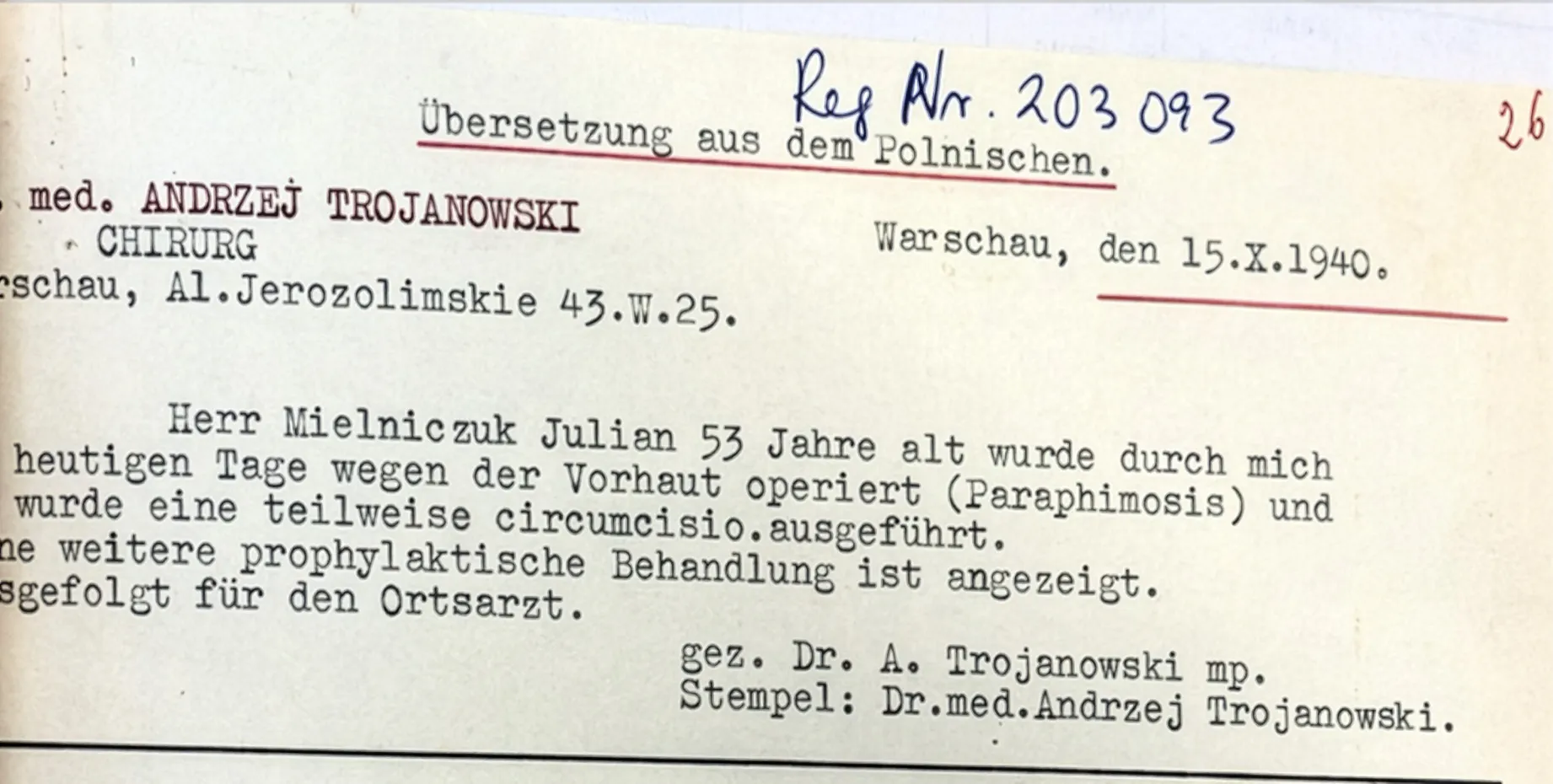
The operation was not the only item on The Old Man’s agenda for that day. He was also baptized, with the good Dr. Trojanowski as his witness. Dr. Trojanowski, it turns out, was doubling as a priest. The doctor wrote the following note:
2. Dr. Trojanowski’s note confirming The Old Man’s baptism
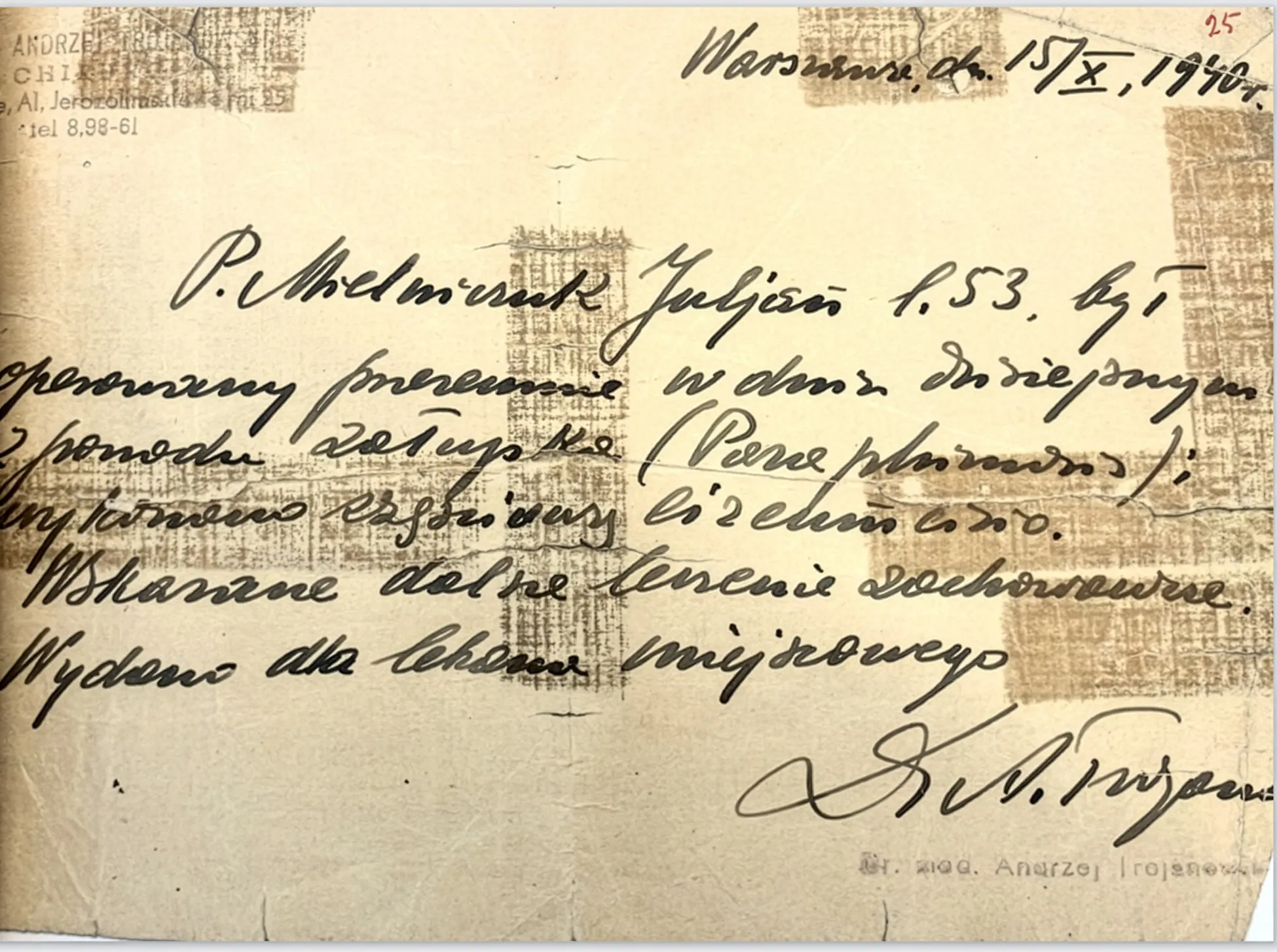
The note states the following:
“To the Reverend Father Wilhelm Juliani, St. 53, No. 7
We respectfully request that you kindly issue a certificate confirming the fact of baptism (przechrzest), performed in accordance with the Church regulations. The certificate is required for official purposes. We kindly ask that it be issued urgently.” Followed by signature.
[signed] Rev. Andrzej Trojanowski”
A faded text below the signature confirms that this Reverend is none other than the same Dr. Trojanowski who performed the circumcision. Coincidence?
These documents raise more than a few questions. First, who is Julian Mielniczuk? Was that my grandfather (aka The Old Man)? Why did he call himself by that name? Next, what happened on that very special October day that caused the Old Man to erase his Jewish heritage? To remind you, he did not have to be baptized or circumcised to save his life—yet. At the time, he was living under Russian occupation, and killing Jews was not part of the Russian agenda. In fact, Lwów’s Jewish community was quite upbeat about life under the Russians.
But wait! What if his baptism was not driven by fear of persecution but rather by a conscientious decision to convert? This seems like the simplest solution—Occam’s razor. But there is no indication of that. My father never once reported noticing The Old Man experiencing a religious awakening of any kind. And if he had experienced some sort of religious awakening, it did not manifest itself in any way, neither in 1940 nor later.
Having gone through the process of elimination, let’s look more closely at the newly baptized convert. Although the baptism certificate does not mention a name, the medical note does mention the mysterious Julian Mielniczuk. And yes, I know this name. I recognize it well. This is the Aryan name taken by The Old Man, my grandfather, while he was hiding from the Nazi persecution.
But, again, the Nazis weren’t around yet in 1940, and he had no reason to worry about Nazi persecution. There was no reason for him to live under an assumed name.
Yet this same name, Julian Mielniczuk, was mentioned in my father’s autobiography next to the forged Nazi ID card, the Kennkarte:
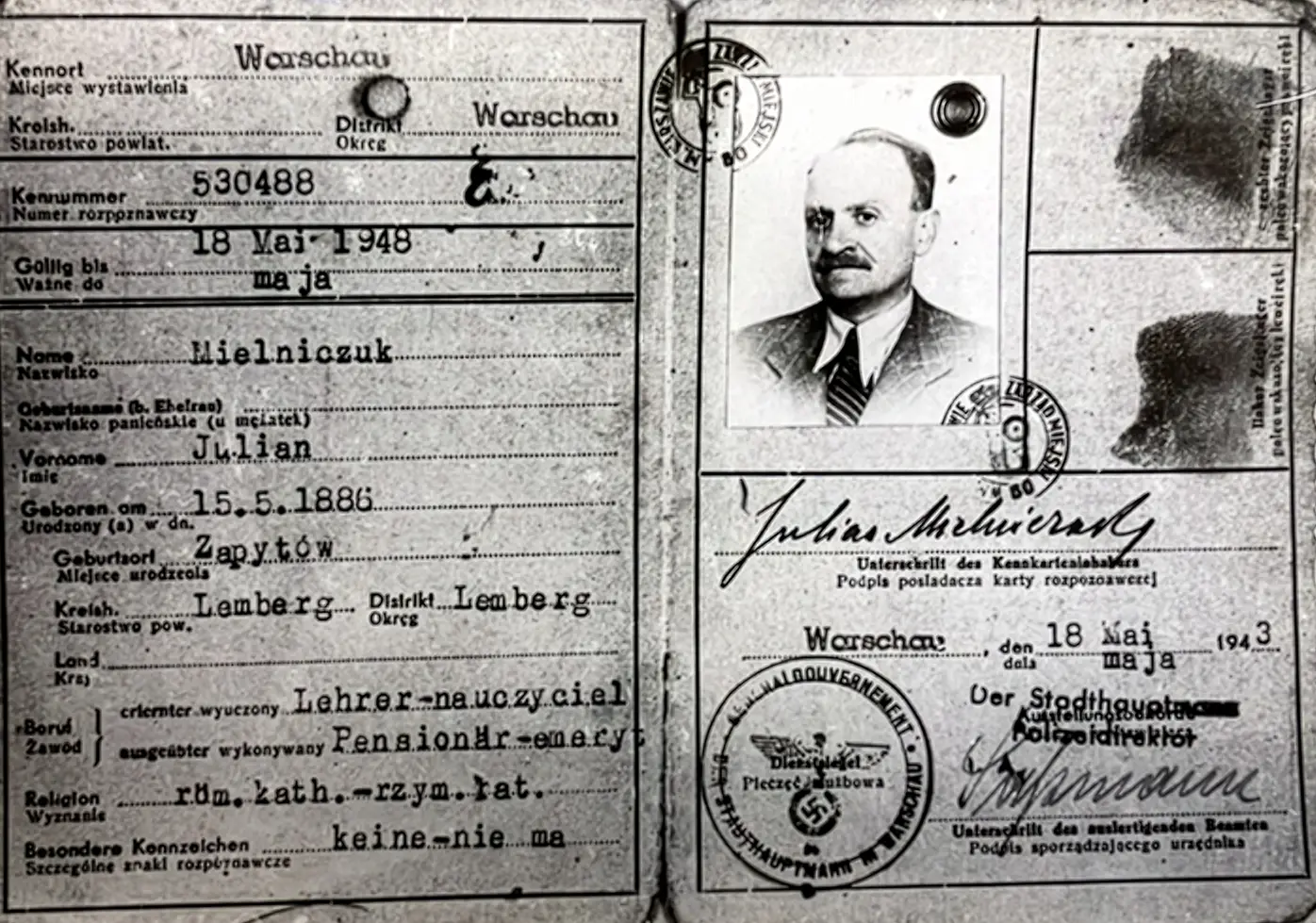
I recognize the face on this card. Definitely. It is The Old Man, Moshe Rubin, my grandfather. But the Kennkarte was issued in Warsaw in 1943. In 1940, when the name first appeared, The Old Man was still living with his family in Lwów, and everyone was still using the Rubin name. As I mentioned earlier, they were living under Russian occupation at the time and did not need to hide their Jewish identities. Warsaw, on the other hand, was already under German occupation by that time, but it’s very unlikely that The Old Man was allowed to travel there—or even wanted to. The only way to get there was to illegally cross the border between the German and Russian-occupied zones, which would be about as tempting as taking a swim in shark-infested waters.
Even stranger is the fact that The Old Man would not have dared to hold a Nazi ID while living under the Russians. If they found this document in his possession, they would have assumed The Old Man was a Nazi spy and executed him summarily.
One thing is for certain: the 1940 documents are fake. Perhaps the most logical assumption is that starting in 1943, with the help of the brave Dr. Trojanowski, The Old Man created a retrospective paper trail to hide his Jewish past. The two documents provided by Dr. Trojanowski—and dated three years earlier—would support The Old Man’s Kennkarte application, allowing him to move through Nazi-occupied Warsaw in relative safety. Of course, the documents had to predate the Nazi occupation. The Nazis would not have trusted them otherwise; they would have looked suspicious.
However, this only partially solves the mystery. I can understand how the doctor’s note helped explain the shape of the Old Man’s penis as a medical necessity, but the baptism note is different, since it did nothing to protect him; the Nazis would not have cared if he were baptized. If you were born Jewish, even baptism would not make you a Kosher Aryan, a case in point being Edith Stein, aka Saint Teresa Benedicta.
Why, then, was the baptismal certificate issued?
I have narrowed this mystery down to two possible explanations. The first is that the certificate was Dr. Trojanowski’s way of requesting Father Juliani to admit Julian M. to his congregation. The second—and I suspect this was the case—is that The Old Man requested this piece of paper and kept it in his possession as an added insurance. During the early days of the occupation, the Warsaw Ghetto’s Jews shared a common yet false belief that baptism would give them an extra layer of safety.
The Kennkarte is also a fake, although the picture on it is real. It captures what must have been a terrifying moment in The Old Man’s life, freezing it for eternity: It was taken at the Nazi’s Warsaw police station. One would never guess this from the way The Old Man looks calmly at the camera. Yet, one little mistake, one slip of the tongue, someone passing by and recognizing him, a request to drop his pants, and he is a dead man. Or not … because of the documentation provided by Dr. Trojanowski.
Having achieved a reasonable understanding of the Dr. Trojanowski connection, I set out on a mission to find some information on the saintly doctor. Public records showed that a Catholic priest named Andrzej Trojanowski was active in Warsaw in the 1940s. There are also records of a practicing medical doctor named Andrzej Trojanowski living in Warsaw at the same time. Multiple historical sources have documented his identity and activities.
My research concluded that Dr. Andrzej Trojanowski (1905–1964) was a Polish surgeon who lived and worked in Warsaw before and during World War II. He completed his medical studies in Warsaw and, before the war, was a surgeon and medical practitioner. During the Nazi occupation, he worked—at least on and off—at Szpital Dzieciątka Jezus (Children of Jesus Hospital) in Warsaw.
Dr. Trojanowski was also involved in the Polish underground, where he provided humanitarian medical aid, including helping Jews in hiding by performing surgical procedures (e.g., removing signs of circumcision). After the war, he continued his medical career, becoming a doctoral lecturer (“docent”) at the Warsaw Medical Academy and later directing surgical clinics.
Dr. Andrzej Trojanowski is the guy who saved my grandfather’s life. But his involvement with the Rubins did not end there.
The Old Man was not the only Rubin to visit Dr. Trojanowski’s clinic in 1943 to obtain an “Aryan Penis” medical note. He also instructed his son, my father, to undergo the surgery, and he trusted the good doctor with the job.
My father recounts this affair in his autobiography [Rubin, A., Against all Odds – Surviving the Holocaust, 2005]. The event occurred in Warsaw in 1943, he wrote. Instead of requesting a doctor’s note explaining his circumcision like his own, The Old Man instructed him to undergo a risky medical procedure to eliminate any physical evidence of his circumcision. The idea was to perform a cut-and-paste operation: Remove skin from his scrotum and attach it to the tip of his penis. Why not apply the same procedure to The Old Man? Perhaps the theory was that Artur’s youthfulness improved the chances that such an operation would succeed. Perhaps.
Unsurprisingly, the procedure failed. Artur, covered in bandages and stitches, was told to steer clear of excitement—something not easily done at seventeen. The good Dr. Trojanowski repaired the damaged penis twice, trying to restore it to its Aryan glory. To no avail. And then he gave up.
This is my father wrote about this experience years later: “While I was living in Żoliborz [in Warsaw], I allowed myself to commit an act of desperation that violated my human dignity more than anything I had endured before. I turned to a surgeon [The Old Man arranged for it] to have an operation performed on me that was intended to make my Jewish origin unrecognizable. This operation was particularly painful. I had to wear bandages for a long time and adhere to a strict diet. In the end, it turned out that the operation had failed. I suffered from the consequences of this operation not only physically, but above all psychologically, and believed that I would not have the strength to survive this experience.” [Personal document]
He did survive, though, and went on to have a full life. Still, while the physical scars might have faded, the emotional and psychological scars would run more deeply through his life.
Epilogue
With enduring gratitude to Dr. Andrzej Trojanowski, whose kindness did not end with those he helped but extended into generations he never knew.
If any of his relatives or descendants encounter this remembrance, I would be honored to hear from you. Please send me a note. Yoram.
