Book Excerpt
Amalie and Friends, Vienna, 2011
Amalie first became a real person to me when I stood next to her grave at Vienna’s Jewish Cemetery, almost 80 years after she died. The opportunity to connect with her took place in 2011, during a visit to Vienna for a conference. I skipped one of the morning sessions to pay homage to a lady, my grandmother, whom I had never met.
Musings. This was my first-ever visit to Vienna. I felt much more comfortable visiting Germany, although I had my share of awkward moments there as well. Once, while walking in Leipzig’s central train station, I noticed two policemen walking toward me. And no, they were not aiming to arrest me. They just walked casually, chatting amiably, as you would expect of German policemen. Yet as they came closer, I imagined telling them, “Schau mich an, ich bin Jüdische!” [Look at me, I am Jewish] just to see how they would react. They surely would arrest me for being a public nuisance, right? They should! Being arrested in Leipzig’s Hauptbahnhof and spending a night in jail could be a real treat, a moment to cherish. What an experience that would have been. I could stare at my elders and claim that I, too, was arrested in Germany—the complete German experience.
Still, Germany had a different feel for me. It now had Adenauer, Brandt, Kohl, and Merkel, right?
Austria was a different experience altogether. Seeing elderly folks in the street, I would try to penetrate their minds and guess what they had done during the War. Hey, you, the guy with a von Hindenburg mustache, did you cheer for Hitler in the streets when he entered Vienna riding his super Mercedes? Did you inform the Gestapo about Jewish U-Boots [submarines, literally, meaning people in hiding] hiding nearby? I never asked questions like these of real people. Not in Austria. The one time I dug a bit, a German colleague led me to conclude that all the Wehrmacht’s soldiers served as either radio operators in France or as guards at the gates of the German embassies in Portugal or Switzerland.
But Vienna has Stolpersteine. Stolpersteine are stumbling blocks, literally, with metal plaques on top. They are embedded in the sidewalks, slightly protruding above the other stones. You can run into one anywhere in Vienna. If you hit one with your foot, after cursing a bit, you will bend over to read what the plaque says. It has names on it. The names and life dates of Jews, Sinti, and Romani people, homosexuals, physically and mentally disabled people, Jehovah’s Witnesses, black people, and many others, all Viennese residents, who lived in the adjacent building and were deported by the Nazis to concentration camps. There are hundreds of Stolpersteine everywhere, all over Vienna, in main streets and narrow alleyways. You run into them by chance, and that’s what makes them so evocative. Perhaps you have just bought yourself a coffee at the corner café, walked a few yards, and run into a Stolperstein. You will know. Someone who lived nearby was murdered.
Whenever I ran into a Stolperstein, I would stand next to it, look at the nearest building’s entrance, and imagine the deportees rushing out of it. Did it happen at night? Very likely. Did they come out of the building peacefully? No. Were they pushed, shoved, and yelled at? Most likely. Did the children cry? You bet they did. Did they know where they were heading? No, they were lied to. Were there dogs around to scare them? You bet there were dogs.
The Viennese went out of their way to be nice to me, but it felt awkward. The receptionist at my hotel—did she suspect a little bit of drama when I showed her Amalie’s certificate of burial and asked for directions? What was she thinking? Perhaps “Ist dieser Jude hier, um ärger zu machen? [This Jewish guy, is he here to cause trouble?].”
When I reached the cemetery, it was a chilly early morning. The caretaker, a man in his 70s wearing a long, dark coat and a skullcap, sat on a bench next to the gate. I showed him Amalie’s burial certificate.
“Amalie Rubin is my grandmother,” I said.
The caretaker inspected the document and muttered, “Year of death 1933; it is a good time that someone has come to visit the poor lady.”
That’s a caretaker with an attitude, I thought.
“What do you mean?” I inquired. It seemed he had a personal connection with the folks under his supervision.
“You will see,” the caretaker said. “Just follow me, young man, and I’ll show you where the grave is.”
He led the way, aided by a walking cane, and I followed him from a few steps behind. I was surprised by how fast he walked, cane and all. He stopped after a few minutes, turned left, and pointed at Amalie’s grave. Her body—or what remained after cancer and time took their toll—was just a few feet away. Here rests the woman, I thought, who, under different circumstances, would have been a part of my life. She was a terrific mom and would have been a terrific grandma. She was young enough for me to have known her had she survived cancer and Hitler.
The first thing I noticed was that she had died on the same day of the year I was born. The probability of this is less than a third of one percent. Not a miracle, but close, and a sign of continuity of some sort. She felt alive at that moment and present in my body. I borrowed that idea from the Buddhist monk Thich Nhat Hanh.
Musings. Are you trying to impress anyone with your knowledge of Buddhism? I am clueless about Buddhism. My sister-in-law sent me that quote, and I liked it.
Amalie’s funeral has taken place here. I imagined it as modest, with The Old Man and perhaps a couple of gravediggers. There may have been others—and me, now; I felt like I was also attending her funeral, only 80 years too late.
Four names were posted on the gravestone next to the places and times of death. I recognized the top two:
Amalie Rubin, Vienna, 1933
Paula Rubin, Warsaw, 1943
The remaining two were completely unexpected:
Jenny Markussohn and Karl Birnbaum, Auschwitz, 1944
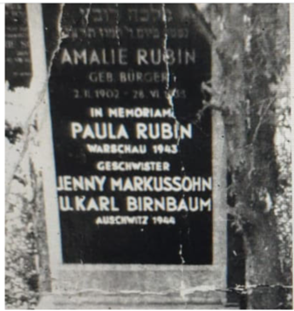
Amelie Rubin's tombstone, Vienna
These four names were etched onto two black metal plaques. The top plaque displayed Amalie’s name in dusty gray-white letters. The lower plaque, displaying the other names, looked newer—fresh, shiny, and white.
Musings. At school, I was told that 6,000,000 Jews were murdered in Europe during the Holocaust. That’s a large number. How can you relate to such a number? How can one put faces on 6,000,000 dead Jews? I pictured them as a vast ensemble of ghosts—faceless, shapeless, and nameless. I knew the numbers—how many had come and where they came from—and I knew where their lives had ended, but individuals were rarely mentioned.
And they had walked to their death like sheep to the slaughter, so we were told. That was the official mantra. It was common knowledge—sheep to the slaughter. If there was one statement that could get my Aunt Hava out of her happy zone, that was the one. “Go ahead, ask your teachers,” she would say, “how brave they would feel standing in an open field with their children while being surrounded by armed SS soldiers and vicious dogs.”
However, it happened, we grieved for them. Or maybe it was that we grieved for ourselves and our misfortune. Because you cannot grieve for something you do not know and do not respect. They were not praised as heroes. Role models? No way.
Four names and one body six feet under. No faces yet. I had no pictures. But I had names to distinguish them from the ensemble of nameless ghosts. They were more than just history book statistics or mindless victims; they were real people with stories to tell. Were they role models? It did not matter to me. But surely, they did not deserve to be remembered as dead sheep. They were real people with dreams and plans. It could have been me standing by their side on the train to Auschwitz.
“Do you want to say Kaddish?” the caretaker asked as he rummaged through his pocket and handed me a crumpled, yellowed piece of laminated paper with Hebrew writing on it and a yarmulka.
“We need a minyan for the Kaddish,” he said, “but I don’t know that we can get 10 Jews around here on a nice, clear day …. Go ahead, young man, say the Kaddish, it is a mitzvah, and I won’t tell the rabbi.” A caretaker with a sense of humor. I started to like him.
Standing next to the gravestone, I mumbled, “Glorified and sanctified be God’s great name … May there be abundant peace from heaven, and life … He who creates peace in His celestial heights, may He create peace for us …” It did not feel right; Amalie, for all I knew, was not into Jewish prayers. But as I reached the end of the prayer, it felt just right. I just needed to say something with gravitas, and the Kaddish… it felt just right.
When I finished, the caretaker gestured to me to come over and sit next to him on the bench. He reached inside his coat and produced a flask and two shot glasses. He placed the glasses on the bench, poured some amber-colored liquid into each one, and handed one to me. We clinked the glasses and drank the contents in one gulp.
“Baruch Boreh Pri Hagafen,”1 the caretaker said, the traditional blessing of the wine.
Musings. This was not wine. And this was one very lonely caretaker. A Jewish caretaker in Vienna … if there ever was a dying business.
“Is this brandy kosher?” I joked.
He chuckled as he poured another round and answered, “This brandy is blessed by the Honorable Cardinal and by His Excellency the Chief Rabbi; God bless them.”
We clinked our glasses again and said, “Le’Chaim.”
He then pointed to the concrete slab below the gravestone.
“See these little stones on top of the concrete slab? These are visitation stones.” Seeing my dumb expression, he added that each stone stands for one visitor. It is a mitzvah for visitors to lay a stone on the grave. The stones weigh on the dead, making sure they remain in the grave and leave the living alone. The more stones on the grave, the better. He added, “Only two visitors in 80 years … That is not a lot.”
Musings. There were two cobbles lying on top of the slab. These were stones from two different rivers. One was light in color and looked like a mixture of carbonates and sandstones. Must be a Danube River stone. The other was dark in color, and I suspected it was mostly granite. A Jordan River stone? Maybe. These were not stones you would usually find while strolling between the graves of the Old Vienna Jewish cemetery. The Jordan River stone, if true, implied that someone from Israel had visited this grave.
“See the grave over there?” The jolly caretaker added. “Many visitation stones … Must be a happy family. Now, be a good boy, find a stone somewhere …”
I looked around and fetched a little stone. I dusted off the dirt and laid it on the marble slab. I wished I had brought one from the Sacramento River in California.
Musings. Four names. Eighty years. Three visitation stones, including mine. And four names. I had come for Amalie and won three more names to figure out. No one ever mentioned a gravestone with four names.
I knew of Paula. I’d heard her name before. She was The Old Man’s second wife, and my beloved Aunt Hava’s mom. She’d raised Amalie’s children from an early age. Arnon had loved her very much.
I should call Hava right away and tell her about the tombstone, I thought. Luckily, the cemetery had Wi-Fi—as the caretaker said, “You never know who might need it.”
“Who would have thunk it?” I responded. This seemed like a pretty cool answer—I’d borrowed it from somewhere—but the caretaker did not smile.
Hava’s first question when answering my video call was, “Who died?” I explained where we were and pointed to the caretaker.
“Why are you hanging out with gravediggers?” was her second question.
I showed her the gravestone. She fell silent. Hava was six years old when Paula was murdered in Warsaw.
“Did you know that Paula’s name is on this gravestone?” I asked.
No answer. No further questions, your honor. It was enough of a shock.
“You stayed with The Old Man in Vienna after the War, right?”
“I called him Daddy,” she said.
Musings. Jenny Markussohn and Karl Birnbaum: Who were they? How did their names end up on this gravestone? Were they family? Someone wanted their names on a familial gravestone, right? The gravestone stated that Jenny and Karl were “geschwister”—siblings. Had they known Amalie or Paula? There must be a connection.
I pulled out the burial certificate and showed it to the caretaker.
“I see four names on the gravestone … and these three, Paula, Jenny, and Karl … they are not mentioned in the certificate. Could there be some information about them in your office?” I asked. He examined it momentarily and returned it. He waved his hand in dismissal, tilted his head sideways, and produced a big Mona Lisa smile. Brandy will do that to you, I thought.
“Do you recognize any of these names?” he asked, and I told him what I knew. He looked like this glorious morning could not get any better. “What was so funny?” I thought. I found the answer quickly.
“Young man,” he said, “I’ll tell you this … two wives on the same gravestone … I never saw anything like that. What chutzpah. It must have been your Zaideh … he is probably the one behind this. See, this happened often after the War. Folks were returning from the death camps or coming out of hiding or returning from Siberia or wherever, and they wanted a place where they could grieve their dead relatives. There were no bodies to bury. The dead went up to the sky in smoke and flames. The surviving relatives … they did not have a single groschen in their pocket. They did not ask permission to post the plaques with their relatives’ names. They just did it. No one dared to stop them. The Allies were in control of Vienna. But two wives on the same gravestone … what a character he must have been.” He sounded sober, like a deacon.
The Old Man was behind this. He must have been. He was not one to be intimidated by the caretakers of Jewish cemeteries. And possibly, there was no caretaker in charge at the time.
He’d survived the Nazis, The Old Man. You do not do that by following the law. He’d survived the War. He’d lost his much-beloved wife, Paula, a couple of years earlier. Before that, he’d lost his first wife, Amalie. He’d lost many of his relatives during the War, and Jenny and Karl were most likely among them. He’d also lost his thriving antique and art business in Nazi-occupied Poland and needed a plan. He needed a place to mourn, and he found it in the Jewish cemetery.
Musings. But why keep the communal gravestone a secret instead of making it a place of pilgrimage and grieving? Stop being a Sherlock and give us a hint. OK, well, rumor had it that the two wives did not get along too well. After the War, everyone’s nerves were raw, and there were several people, I suspect, who would have gotten upset seeing the two names together.
And what about Jenny and Karl? Right there and then, I decided: blood relatives or not, Jenny and Karl are family. The logic is simple: they cohabit the same gravestone as my grandmother, Amalie, and my step-grandmother Paula. They were murdered in Auschwitz. And they were lonely in Vienna … only two visitation stones in 80 years. Well, three in fact, if you consider mine.
Aunt Jenny and Uncle Karl—there’s a nice ring to it. But who were they?
1“Blessed be He who created the fruit of the vine”; a blessing said before drinking wine.