
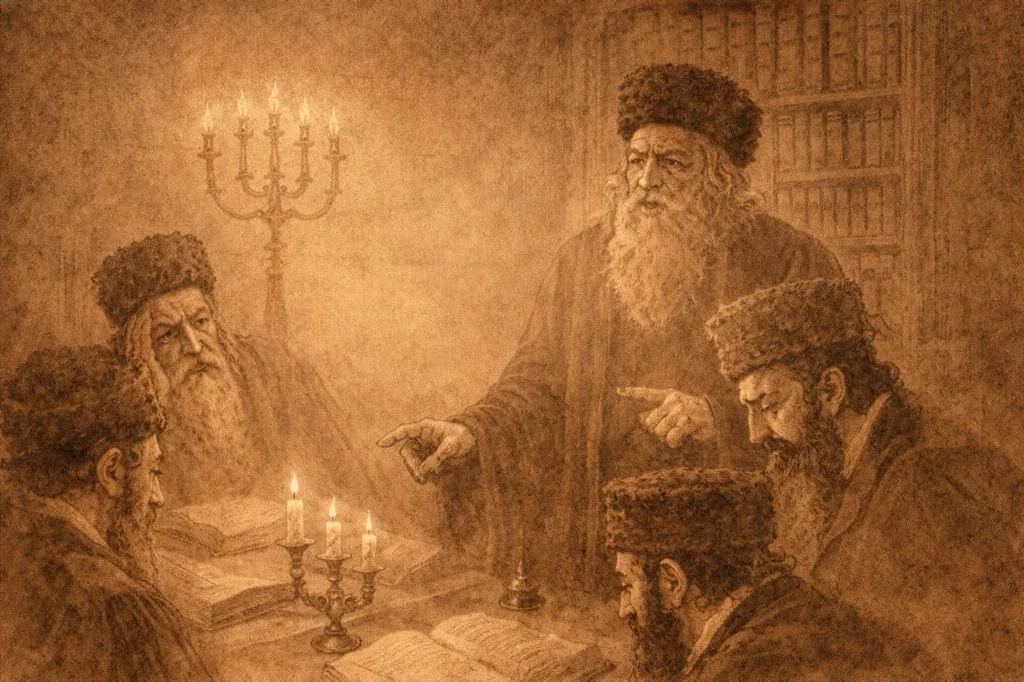
Herem is a Hebrew word. In religious circles, it used to could be viewed as an elegant way to impose social, economic death. It means communication with any members of your family and community is forbidden and punishable. It is forbidden to provide you with any sort of support. If you were a religious person, that was a very sad situation. Why am I telling you all this? It is not just curiosity. This story has a strong connection with my family’s history.
Part 1: Herem’ed by the Angels
Herem (חֵרֶם) is a loaded word in Hebrew. It is a formal ban imposed by a rabbinic court. It implies social and religious exclusion: no business dealings, no communal prayer, no burial rites, no contact allowed, no help and support is any way. In short, it means “you are dead to us.” It is used sparingly, but it has devastating effect when applied.
The classic herem’s example is the Spinoza’s ban of 1656 — often cited because the language is unusually fierce. It was set to be an example. Here are a few choice phrases issued by the rabbinical court in Amsterdam. The opening curse is “With the judgment of the angels and with that of the saints, we excommunicate, expel, curse, and damn Baruch de Spinoza…” which means that this is not administrative language. It invokes cosmic authority — heaven joins the court. The goal is not correction or behavioral modification. It is about severance. Next, it goes on by stating that “Cursed be he [Spinoza] by day and cursed be he by night; cursed be he when he lies down and cursed be he when he rises up.” This means that the curse is all encompassing— it covers all time, all bodily states and all movement. Next comes the annihilation clause: “May the Lord blot out his name from under heaven…” which means total erasure. And then the social death sentence, in the form of detailed instructions: “That no one may communicate with him, orally or in writing, nor show him any favor, nor stay with him under one roof, nor come within four cubits of him,” and finally comes the intellectual penalty clause: “…nor read any treatise composed or written by him.” The rabbinical decree does not provide the reasoning for this action to avoid repeating Spinoza’s ideas in public, although they do mention his books, which could be viewed as a tactical mistake on their side.
Religious herems are used rarely. And it seems that rabbinical courts lost their appetite for herem statements angels. The language used in the 1945 herem imposed on Rabbi Mordecai Kaplan in New York looks offers a stark comparison. Much like Spinoza, 400 years earlier, Kaplan advanced a naturalistic view of God as “the sum of the animating, organizing forces in the universe.” He rejected supernatural revelation and conceived salvation as the ethical and social fulfillment of human potential within community. The core declaration of the Kaplan herem is the statement that his ideas on Judaism “deny the fundamental principles of our holy Torah.” and not to mince with words, the statement continues to say that “ [they] hereby declare that Rabbi Mordecai M. Kaplan is separated from the congregation of Israel.” There is neither curse formula, nor invocation of angels and biblical spells. The declaration continues by forbidding engagement with his work: “It is forbidden to study his books or to make use of them.”
In a recent case concerning an alleged pedophile and fraudster, the herem statement is mild in comparison. It states that “… someone who values his soul must stay away from him [the violator] and one is obligated to act in this way.”
In the past, rabbinical courts enforced ḥerems through curses and decrees. Since they lived in the diaspora and had no official authority beyond the Jewish community, they relied on these measures to ensure their rulings were followed. Later, as in the Kaplan case, realizing they face a real chance of civil litigation and intrusive media coverage, the rabbinical courts adopted a more reserved language.
Part 2: The Lived Consequences of Spinoza’s Herem
If you expected some kind of counteroffensive, you would be mistaken—he neither pleaded for mercy before the court, nor recanted any of his beliefs, nor sought to circumvent or disregard the Herem edict. He maintained his lifestyle and did not alter it to accommodate the expectations of his prosecutors.
The 1656 ḥerem on Baruch Spinoza sought total social exclusion. That was its intended purpose. At the age of twenty-three, he was officially severed from family, livelihood, communal worship, charity, and burial rights, and placed beyond the bounds of permissible social contact. Economically, the ban forced him into a life of material hardship, sustained by manual labor and modest means, which he accepted in order to preserve intellectual independence.
Being denied burial rights is a profound religious sanction because it extends exclusion beyond life itself. In traditions where burial affirms belonging to an unbroken chain of ancestors and descendants, denial symbolically severs that bond, removing the person from communal memory.
Did that herem achieve the outcome that the herem prognosticators hoped for? Spinoza did not write to share his personal views, but some circumstantial evidence may provide insight into them.
Intellectually, the herem did not shutter Spinoza’s creativity and writing. If anything, it freed him from confessional obligation he might have had. Still, he refused to be outright confrontation and arranged through his friends to have his work published after his death. He did get high recognition during his lifetime. In 1673, he was offered a professorship at the University of Heidelberg. He refused out of concerns that it will compromise his freedom and philosophical compromise. I can only speculate that the herem made him attractive in academic circles: it put him at equal footing with Galileo Galilei. Like Galileo before him, Spinoza was disciplined by religious authority for ideas deemed dangerous—but where Galileo was silenced within the Church, Spinoza was expelled from his community altogether
There’s the name change factor to consider in this context. Spinoza change his Hebrew name from the Baruch to the Latin form, Benedictus. It was a defensive move of primary importance. There are several reasons to explain the name change: a cluster of practical, cultural, and symbolic reasons—none of them a formal “conversion,” but all of them telling. The shift from Baruch to Benedictus was neither a rejection of his origins nor a gesture of religious conversion, but a deliberate act of translation and positioning. The two names mean the same thing—“blessed”—yet Benedictus belonged to the Latin language of philosophy, correspondence, and publication that defined the Latin-speaking community of early modern scholars who exchanged ideas through books and correspondence. This was the community where Spinoza chose to work. After the ḥerem severed him from the Jewish communal world of Amsterdam, the Latinized name also eased his social existence among Christians and freethinkers, minimizing friction without signaling allegiance. At its core, this transformation was about reshaping his identity and about resilience. Psychologically, the ḥerem produced neither retraction nor dissent but a posture of deliberate withdrawal and restraint. The community sought to erase his name; instead, it forced him to seek support and friendship in other communities.
Spinoza did not lead a happy life, neither by the standards prevailing at his time nor by those prevailing today. He lived alone, remained unmarried, was (officially) estranged from his family, had few friends, and died young—probably due to illness from his work grinding lens. But these are standards, and there is -nothing standard about Spinoza. He never described himself as happy or fulfilled, nor did he show resentment or try to lift the herem. But Spinoza had his own definition of happiness. From Spinoza’s perspective, happiness isn’t pleasure, belonging, recognition, love, or success. It is the intellectual love of God—clear and necessary understanding of reality.
Several other factors combined to mitigate if not outrightly negate the impacts of the herem. First, there is the Family factor to consider. Spinoza’s family history is critical in that regard. Spinoza was not sent to an unfamiliar world. His family already lived with internal religious plurality. Steven Nadler, in Spinoza: A Life (Cambridge University Press, 1999), documents that Spinoza’s family were New Christians (conversos) from Portugal, with relatives, including his stepmother, who had lived as Christians and that confessional boundaries within such families were often fluid rather than absolute. Yosef Kaplan, From Christianity to Judaism (Oxford University Press, 1989) show that many families of similar background contained Jews, crypto-Jews, and practicing Christians simultaneously—sometimes across generations. Both scholars conclude that Spinoza was not erased by his family. He seems to have been allowed to remain kin and he maintained social contacts primarily with his cousins. That quiet, constrained acceptance contrasts sharply with the absolute language of the ḥerem—and helps explain how Spinoza could live nearby, under his own name, without vanishing entirely from family life. To use modern terminology, the religious environment where Spinoza grew up and where he lived was not simply binary, and as a result, it tended to be more accepting of different perspectives.
The Family History Factor. Spinoza’s family and community had survived the harsh persecution of the Portuguese Inquisition. They were ready to handle the Amsterdam rabbis. The Amsterdam rabbis were no match for the Portuguese Inquisition. They lacked enforcement authority, except in cases involving individuals who accepted the moral authority of the rabbis without constraint and who were genuinely concerned with their statements and decisions.
There’s an anecdote that comes to mind. Apologies for the detour. When Stalin was warned about the Pope’s mighty influence on the Christian world, he responded by asking; “How many divisions does he have?” He should have listened. John Paul II comes to mind. There’s no direct comparison with Stalin, but the Amsterdam rabbis did not have any division at their disposal. They counted on the angels.
Equally important is the support Spinoza received from his friends. His circle after the ḥerem was small, discreet, and almost entirely non-Jewish: Mennonites, physicians, publishers, and freethinking Christians who shared a distrust of religious authority and a commitment to reason. They provided him with intellectual companionship, financial insulation, and protection from exposure, forming a chosen family that replaced communal belonging with voluntary loyalty and shared risk. And then there’s the dress rehearsal factor. Spinoza was ready for the community’s herem, aware of what to expect and how to respond.
